
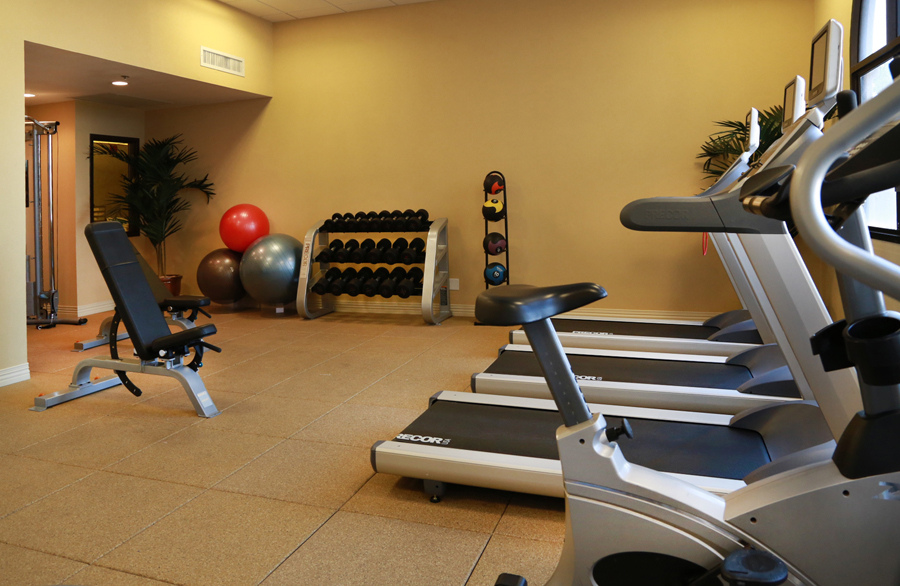
The short answer: to stay fit while traveling for work, stop trying to reproduce your perfect home routine. Set a travel-week floor: move every day, complete two brief full-body strength sessions when the trip lasts most of a week, and decide your basic food rules before the first restaurant menu appears.
The goal of a business trip is usually continuity, not peak performance. You are working around flights, meetings, unfamiliar equipment, restaurant meals, and sleep that may be less predictable than usual. A smaller plan you complete is more useful than an ambitious plan that never leaves your notes app.
That is the Lean by Habit approach to travel: define the minimum actions that protect the routine, make them easy to start, and return to normal training without punishment when the trip ends.
Build a travel-week floor, not a perfect itinerary
Federal physical-activity guidance remains a useful long-term destination: adults should work toward 150–300 minutes of moderate aerobic activity each week and strengthen the major muscle groups on at least two days. It also says that any amount of activity is better than none and that people who are inactive should start with small amounts and build gradually.
Travel does not suspend that guidance, but it changes the logistics. A travel-week floor translates the recommendation into three anchors you can control:
- Movement floor: at least one intentional walk or other aerobic bout each day.
- Strength floor: two full-body “touches” during trips that occupy most of the week.
- Food floor: a protein-and-produce default at the meals you control.
These are not magic numbers and they are not individualized medical advice. They are planning rules that keep the most important categories alive until your normal environment returns.
Choose the plan by trip length
Do not give a one-night trip the same planning burden as a two-week assignment. Match the floor to the disruption.
| Trip length | Primary goal | Useful minimum |
|---|---|---|
| 1–2 nights | Protect movement and sleep | Walk during travel and complete one 10-minute reset if time allows |
| 3–5 nights | Keep strength and cardio in the week | Two brief strength sessions plus a daily walk |
| 6+ nights | Run a scaled version of normal training | Two strength sessions, two or three aerobic sessions, and one recovery day |
If a trip begins after a hard training week, the best use of travel may be maintenance and recovery. If you arrive fresh and the hotel gym is well equipped, you can do more. The floor is the promise; anything above it is optional.
The five-minute pre-trip setup
You do not need to research every dumbbell in the hotel. Before leaving, make five decisions:
- Choose two workout windows. Put them on the calendar around the meetings least likely to move.
- Inspect the hotel gym once. Look for a safe place to walk, basic cardio equipment, dumbbells, a bench, or a cable station.
- Pack one low-friction tool. Shoes and a light resistance band are usually enough. Avoid improvised door anchors, unstable furniture dips, and equipment you have not tested safely.
- Save the workout offline. Do not depend on hotel Wi-Fi or spend the session searching for a video.
- Choose the fallback. Decide what counts if the planned session disappears.
When you arrive, use the Hotel-Arrival Rule: place your shoes, clothes, and band where the next action is visible before you open your laptop or settle into the room.
A hotel workout that survives imperfect equipment
The American College of Sports Medicine’s 2026 position stand synthesized 137 systematic reviews involving more than 30,000 participants. Its central message for general fitness is that consistency matters more than complexity. Home-based training, elastic bands, bodyweight exercises, and circuits can improve strength and physical function, while advanced methods and training to momentary failure are optional for most healthy adults.
That makes travel training simpler. Build the session around movement patterns rather than a specific machine:
- Squat: goblet squat, split squat, or chair sit-to-stand.
- Push: push-up, dumbbell press, or standing band press.
- Hinge: dumbbell Romanian deadlift, band good morning, or glute bridge.
- Pull: one-arm dumbbell row, cable row, or band row.
- Carry or trunk: suitcase carry, farmer’s carry, dead bug, or plank.
Complete one to three rounds. Use a load and variation that leave roughly two to four good repetitions available at the end of each set. A session can be effective without being exhausting.
If bands are your only equipment, use the Resistance-Band Backup Workout for exercise substitutions and progression rules.
Use the three-level fallback ladder
Business travel changes quickly. Decide what to do before the schedule breaks.
| Level | Time | Action |
|---|---|---|
| Full | 25–35 minutes | Three rounds of the five-pattern workout |
| Minimum | 10–15 minutes | One or two rounds, followed by a short walk |
| Emergency | 3–5 minutes | One set each of a squat, push, hinge, and pull—or a brisk hallway walk |
The emergency level is not meant to replace normal training indefinitely. Its job is to preserve the cue-action connection. When a meeting runs late, you still change clothes, start the timer, and complete the smallest useful version. That makes tomorrow’s return easier.
Make the travel day part of the plan
Walking the terminal, taking the stairs when practical, and choosing a distant gate seat can turn waiting time into movement. On road trips, schedule walking breaks instead of hoping they happen.
There is also a health reason to break up long periods of sitting. The Centers for Disease Control and Prevention notes that travel lasting more than four hours can raise blood-clot risk for some people. It advises moving the legs frequently and walking around every one to two hours when practical. People with a prior blood clot or other risk factors should discuss prevention with a clinician before traveling. See the CDC’s current travel and blood-clot guidance.
For time-zone changes, fatigue, and the first day at the destination, use the First 24-Hour Reset instead of forcing a high-intensity workout after poor sleep.
Use food defaults without turning dinner into a test
Travel eating is easier when every meal does not require a new decision. Pick a default for the meals you control:
- Start with a palm-sized protein source and fruit or vegetables.
- Choose water first, then decide deliberately whether another drink adds value.
- At large restaurant meals, pause when satisfied rather than treating an oversized portion as a requirement.
- Keep one portable option—such as jerky, a protein bar, fruit, or nuts—available for delays.
A business dinner is not a failure. It may be part of the work. The goal is to avoid making every airport meal, meeting break, room-service order, and client dinner an exception. Use a flexible default at routine meals so you have room for the meals that matter socially.
The post-trip return rule
Do not “make up” missed workouts with double volume. Resume the next scheduled session at a sensible effort. If sleep, soreness, or travel fatigue remains high, reduce the load or sets for one session and rebuild from there.
A short trip is unlikely to erase your aerobic fitness. The more useful question is whether your routine has a bridge back to normal. The minimum-dose cardio plan for business travel explains how to protect that bridge without cramming a full home week into a hotel schedule.
Your next action
Before your next trip, write down three things: the two workout windows, the minimum fallback, and the meal default. That is enough to turn a vague intention into a plan.
Free resource: The Lean by Habit Program Downloads page includes the free Fit to Travel 100-Day Action Companion, with daily planning and action logs, minimum actions, reflection questions, workout tools, and ten-day checkpoints.
For the complete travel-habit system, Fit to Travel is available through the current book page.
About the author: Jeff Emblen is the author of Fit to Travel and a former U.S. Army Master Fitness Trainer. His Lean by Habit approach combines behavior-change tools with progressive training so fitness can survive busy schedules, travel, and imperfect conditions.


Leave a Reply