
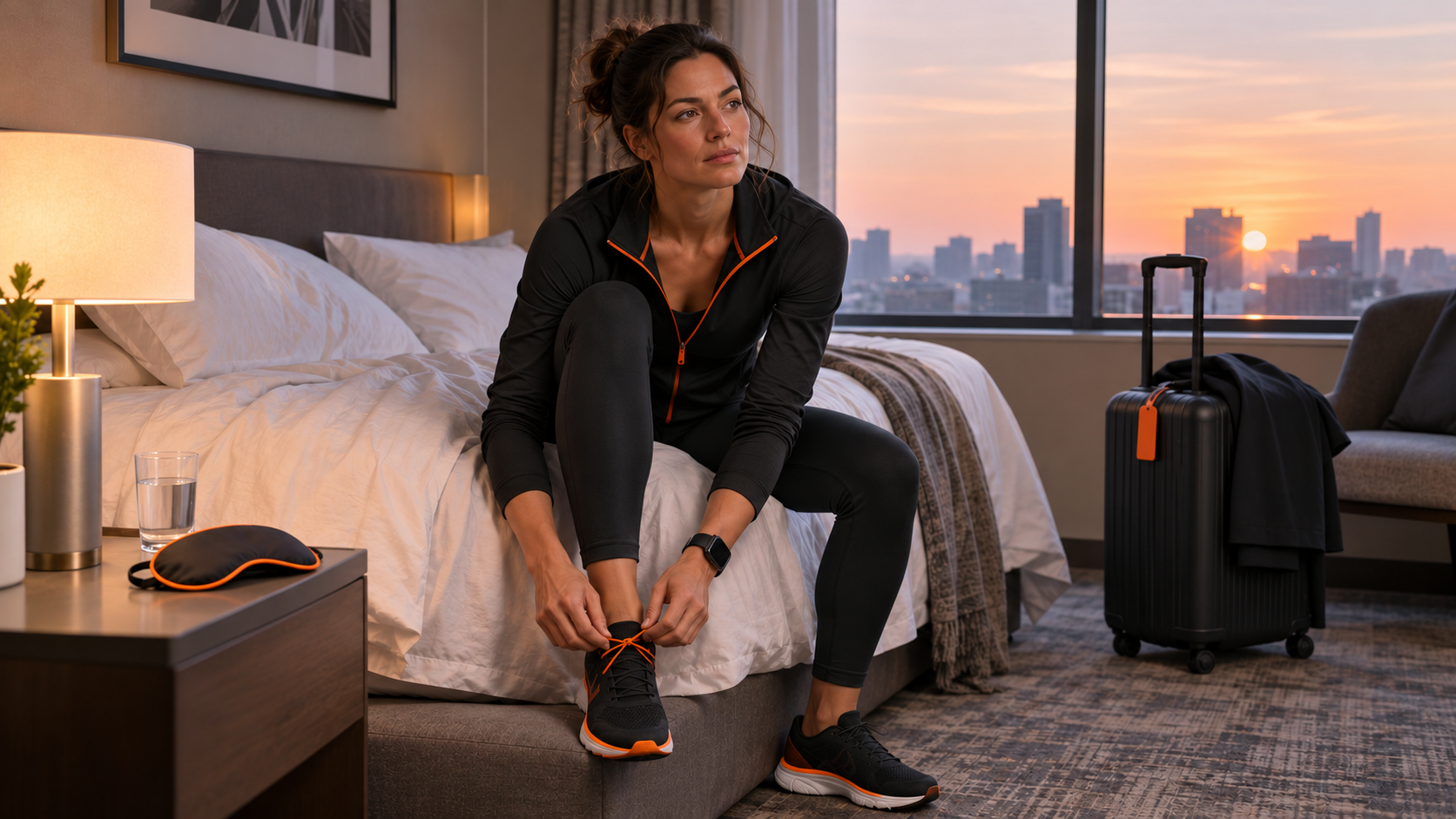
The short answer: You can exercise after a red-eye flight, but do not use a hard workout as a test of toughness—or assume it will make you less sleepy. First run the Lean by Habit Red-Eye Readiness Gate. Depending on alertness, coordination, workout demands, and your next sleep window, choose a modified session, an easy reset, or recovery instead.
The aim is not to “win” the morning after poor sleep. It is to make the best decision for the next 24 hours without letting one disrupted travel day turn into an abandoned week.
Exercise is not a reliable cure for red-eye sleepiness
A systematic review and meta-analysis published November 23, 2026 examined psychological responses to exercise after sleep deprivation. Across six small clinical trials, sleep deprivation may have worsened mood responses to exercise, while a single workout did not consistently reduce sleepiness.
The authors rated the evidence as very uncertain because the studies were small, inconsistent, and at risk of bias. That means the review does not prove that exercise after an overnight flight is harmful. It does challenge a common assumption: feeling active for a few minutes is not the same as restoring alertness.
A broader 2022 systematic review and meta-analysis found that acute sleep loss reduced performance across strength, endurance, power, interval, and skill tasks. The average decline across the included outcomes was about 7.6%, but results varied widely, and 89% of participants were male. The studies also excluded recent jet lag, so the average should not be treated as your personal forecast after a specific flight.
The useful conclusion is simpler: poor sleep can change performance and perception, so the workout should be selected from current readiness—not from the plan you wrote before boarding.
Use the Red-Eye Readiness Gate
Answer these four questions before you train.
1. Are you safely alert?
If you are struggling to keep your eyes open, repeatedly losing focus, feeling faint, unusually confused, or unsafe to drive, the gate is closed. A workout is not a substitute for sleep, and it is not a dependable way to reverse dangerous drowsiness.
Choose recovery. Do not drive while dangerously sleepy. Seek medical help when symptoms are severe, unusual, or accompanied by illness, chest pain, trouble breathing, or another concerning sign.
2. How much skill and force does the session require?
A familiar walk, easy bike ride, machine circuit, or controlled band workout asks less of coordination than heavy free-weight lifts, maximal intervals, sprints, complex Olympic lifts, or an unfamiliar class.
The more precision, speed, balance, or near-maximal force the session requires, the stronger the case for postponing it or choosing a simpler substitute.
3. When is your next protected sleep window?
If you plan to sleep soon after arrival, protect that opportunity. A 2026 sports-medicine travel review notes that exercise timing should be individualized and that strenuous exercise late in the biological day may disrupt subsequent sleep.
If the trip crosses time zones, “morning” on the hotel clock may not be morning for your body. Use the Short-Trip Clock Map to decide whether local time or home time should guide a two-day trip.
4. Have the basics been restored?
Check for ordinary travel friction: thirst, missed meals, stiffness, headache, an upset stomach, or signs that you may be getting sick. Correct what you reasonably can before adding training stress. Do not chase a dehydrated, under-fueled travel day with a punishment workout.
Lean by Habit decision rule: After a red-eye, intensity must be earned by readiness. It is not owed to the calendar.
Choose green, yellow, or red
Green: train, but leave the heroics at home
You are alert, steady, able to concentrate, reasonably fueled and hydrated, and not close to a planned sleep window. Complete a familiar session, but keep it around 70–80% of your usual effort. Skip personal-record attempts, maximal intervals, and technically demanding new movements.
Yellow: use the minimum effective reset
You are tired but functional, mildly stiff, or uncertain about readiness. Use 10–20 minutes of easy-to-moderate work. Walking, mobility, a simple machine circuit, or familiar bodyweight and band movements are reasonable options.
Stop if sleepiness, dizziness, coordination, or how you feel is worsening. The session should leave you feeling more settled—not depleted.
Red: recover first
You are fighting sleep, unsafe, ill, faint, confused, or unable to move with normal control. Skip the workout. Use the First 24-Hour Arrival Ladder to prioritize circulation, light exposure, food, hydration, and sleep based on the problem you actually have.
A 12-minute yellow-day hotel reset
This is a fallback for a tired but safely alert traveler—not a required prescription.
- Two minutes: easy walking or marching.
- Six minutes: two controlled rounds of 6–10 chair squats, 6–10 incline push-ups, 8–12 band rows, and 4–6 dead bugs per side.
- Four minutes: easy walking, gentle mobility, and a readiness recheck.
Keep several repetitions in reserve. If your form becomes sloppy, simplify the movement or stop. The win is maintaining the decision habit without pretending a red-eye morning is a normal training day.
Set up the decision before the flight
Write the three options into your trip plan before departure: Green session, Yellow reset, Red recovery. That removes the all-or-nothing debate at arrival.
Protect sleep before travel with the Departure-Eve Buffer. When you reach the hotel, use the First-Five Room Reset. If caffeine becomes the automatic solution, run it through the Sleep-First Caffeine Gate.
One red-eye does not require a perfect response. It requires a safe next decision and a clear way back to normal training.
The free 134-page companion includes all 100 Fit to Travel Field Orders, daily planning and action logs, minimum actions, reflection questions, workout tools, and ten-day checkpoints. No purchase is required. For the complete travel-fitness system, Fit to Travel is available on Amazon.
Sources and limitations
- Benfica et al., “Psychological responses to acute physical exercise in sleep-deprived healthy individuals” (published November 23, 2026). Only six trials qualified, and the certainty of evidence was very low.
- Craven et al., “Effects of Acute Sleep Loss on Physical Performance” (2022). Results were heterogeneous, participants were predominantly male, and recent jet lag was excluded.
- Vitale et al., “Optimizing Athlete Travel for Performance” (2026). This narrative review focuses on athletes, so its recommendations require caution when translating them to ordinary business travelers.

Leave a Reply