
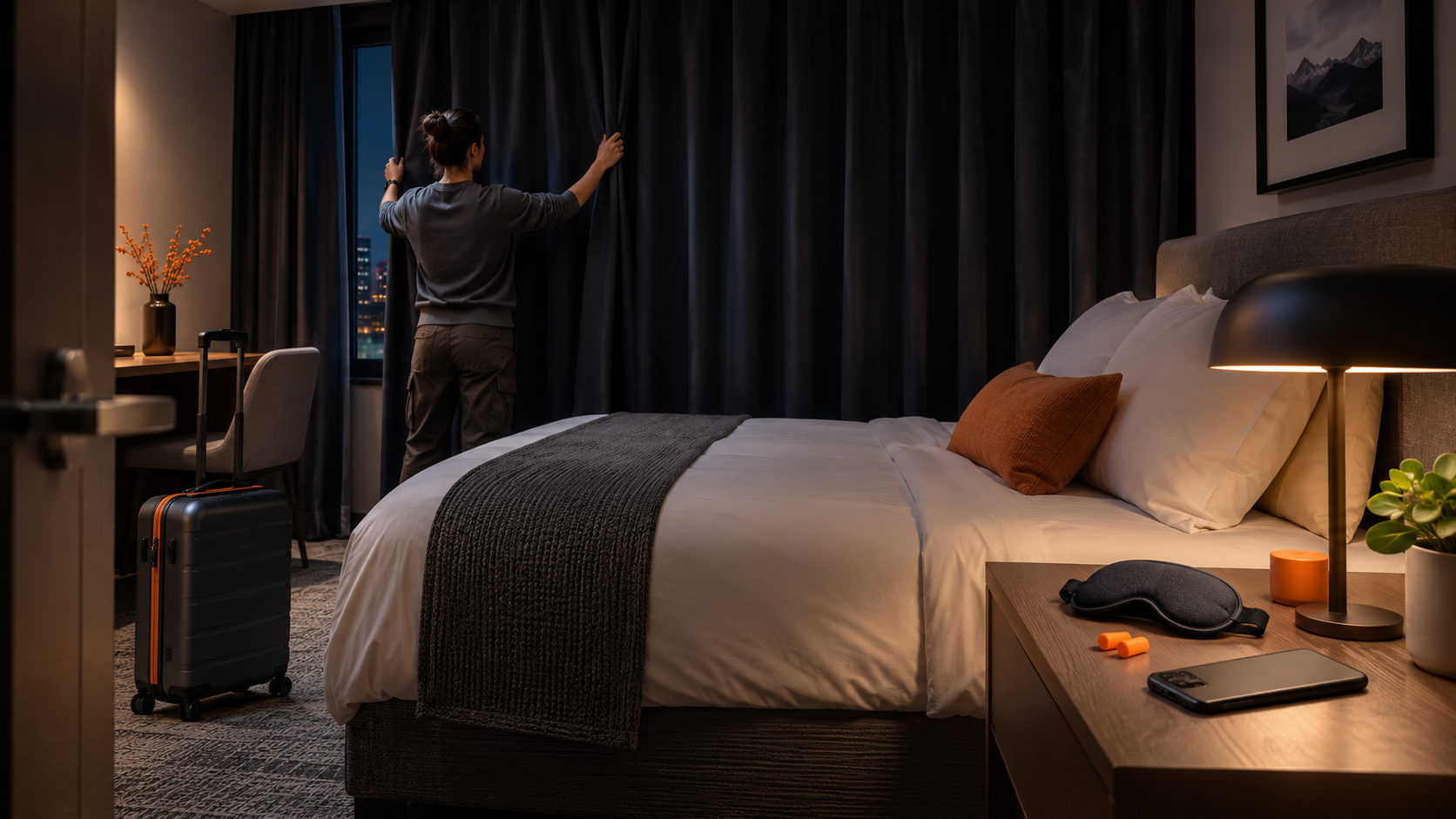
The short answer: You may sleep worse in a hotel because an unfamiliar room adds several small disruptions at once—new sounds, different light, an untested thermostat, unfamiliar bedding, and a broken evening routine. Do not wait until bedtime to discover them. When the hotel door closes, spend five minutes setting up the room for sleep.
That is the Lean by Habit approach: use a reliable trigger—hotel arrival—to make a small, repeatable action easier. The goal is not to create a perfect sleep environment. It is to remove the most controllable friction before fatigue makes every decision harder.
Why the first hotel night can feel harder
Hotel sleep problems are common enough to be recognizable, but they are not all the same. In a 2026 survey commissioned by the American Academy of Sleep Medicine, roughly one in four adults said they sleep worse while traveling. The AASM points to changes in routine, unfamiliar rooms, stress, schedules, and light exposure as possible contributors. Its travel-sleep guidance recommends keeping a consistent schedule when practical and making the room cool, dark, and quiet.
Laboratory research also describes a “first-night effect”: sleep can be lighter or more fragmented during an initial night in an unfamiliar setting. A 2024 polysomnography study found differences in sleep onset, wakefulness after sleep onset, and total sleep time across unfamiliar and familiar environments.
That does not mean one bad hotel night is inevitable. The study was conducted in controlled sleep settings, not across every type of hotel or traveler. It identifies a real pattern, but it cannot tell you exactly how any individual trip will go.
The Lean by Habit First-Five Room Reset
Run this reset before you unpack fully, open your laptop, or sit down on the bed. Five minutes is enough because the routine targets four high-impact variables—noise, light, temperature, and cues—then gives you one repeatable wind-down action.
Minute 1: Listen before you settle in
Stand still. Listen for the elevator, ice machine, hallway doors, street traffic, adjoining-room noise, and the heating or cooling system cycling on and off.
If the problem is structural and a quieter room is available, asking early is easier than moving after you have unpacked. If the noise is intermittent, stage earplugs or another familiar noise-management option beside the bed now.
Minute 2: Make the room darker
Close the curtains and check the center gap from the bed. Turn off or cover nonessential indicator lights that shine toward you. Put an eye mask where you can reach it without getting up.
This is more useful than assuming you will remember later. At bedtime, the friction of finding a mask or fixing a curtain can be enough to leave the room as it is.
Minute 3: Test the temperature
Set the room to a comfortably cool temperature and confirm that the system responds. “Cool” is not one universal number; bedding, humidity, personal preference, and the unit itself matter. The practical test is whether the room feels comfortable before you are trying to fall asleep.
Minute 4: Stage the sleep kit
Put the few things that reduce bedtime decisions in one place: eye mask, earplugs, charger, alarm, and any normal nighttime items you already use. Place the phone face down and out of arm’s reach if you can still hear the alarm.
The point is not that a phone automatically ruins sleep. It is that an unfamiliar room makes “one more scroll” an easy default. Staging the room changes the default before willpower is low.
Minute 5: Choose one familiar cue
Pick one compact wind-down action you can repeat in any hotel: wash up and read two pages, brush your teeth and do three slow breaths, or complete the same short mobility sequence you use at home.
Keep it small enough to survive a delayed flight, a late dinner, or a demanding workday. Consistency matters more than making the routine impressive.
Lean by Habit decision rule: If a sleep problem can be found and reduced in the first five minutes, fix it at arrival—not at bedtime.
What the evidence supports—and what it does not
A study of 609 frequent travelers found that noisy air conditioning, outside noise, and uncomfortable pillows or linens were associated with poorer hotel sleep. Those findings fit the reset, but the study was cross-sectional. It shows associations, not proof that changing one room feature will guarantee a better night.
Likewise, the AASM’s healthy sleep guidance supports a quiet, relaxing, cool environment and limiting bright light near bedtime. It does not establish one ideal hotel-room temperature, one required product, or one routine that works for everyone.
So treat the First-Five Room Reset as a low-cost decision protocol, not a medical treatment. It improves the setup you can control. It cannot erase illness, severe jet lag, chronic insomnia, or every source of travel stress.
What if you still sleep poorly?
Do not turn one rough night into a string of reactive choices. Use the First 24-Hour Arrival Ladder to decide what kind of recovery you need. If caffeine is tempting, use the Sleep-First Caffeine Gate before automatically adding another dose.
For a short trip, also decide whether you should stay closer to home time or adjust locally; the three-clock test for two-day trips gives you a practical answer.
If sleep trouble is persistent, severe, or affecting safety, talk with a qualified health professional. Never drive when you are dangerously sleepy.
Your next trip: make arrival the trigger
Save the five steps—listen, darken, cool, stage, repeat—in your travel notes. Run them as soon as the door closes. You are not trying to force sleep. You are making the next helpful action easier.
The free 134-page companion includes all 100 Fit to Travel Field Orders, daily planning and action logs, minimum actions, reflection questions, workout tools, and ten-day checkpoints. No purchase is required. For the complete travel-fitness system, Fit to Travel is available on Amazon.
Sources
- American Academy of Sleep Medicine, “Sleep better while traveling with these simple tips” (2026).
- Shahveisi et al., “The first-night effect of sleep occurs over nonconsecutive nights in unfamiliar and familiar environments” (2024).
- Robbins et al., “Hotel Room Attributes and Sleep Quality Among Frequent Travelers” (2023).
- American Academy of Sleep Medicine, “Healthy Sleep Habits”.

Leave a Reply