

The short answer: set your caffeine cutoff from the next sleep window you need to protect—not automatically from local clock time. On a short trip, first choose whether you are operating closer to home time, using a partial bridge, or shifting to destination time. Then count backward from that planned sleep opportunity. As a practical default, stop an ordinary coffee about eight to nine hours before sleep; use a longer buffer for a large or unknown dose.
Caffeine can support an important meeting or a drowsy afternoon. It can also borrow alertness from the sleep that is supposed to make tomorrow easier. The travel mistake is not drinking coffee. It is drinking it without deciding which sleep period matters.
The Lean by Habit answer is a simple decision rule: protect tomorrow before you stimulate today. This article turns that idea into the Sleep-First Caffeine Gate.
Why “no caffeine after 2 p.m.” breaks down when you travel
A fixed afternoon cutoff can work at home because your clock, schedule, and bedtime are usually aligned. Travel can separate them. Two p.m. at the destination may be morning to your body. Your planned hotel sleep may also be earlier or later than a normal local bedtime because of a meeting, overnight flight, or quick return home.
The CDC Yellow Book lists caffeine as one tool for sustaining alertness during the biological night, while warning travelers to consider its roughly five-hour half-life. That half-life is not a countdown to zero. It means a meaningful portion can remain in the body hours later, and metabolism varies between people.
That is why the useful question is not, “Is coffee allowed at this local hour?” It is, “Will this dose help the performance window I chose without damaging the sleep window I need next?”
What recent caffeine research changes—and what it does not
A randomized crossover trial published in 2025 tested 100 mg and 400 mg of caffeine taken 12, 8, or 4 hours before bedtime. In the 23 men studied, 100 mg did not produce a statistically significant sleep effect at those timings, while 400 mg disrupted objective sleep when taken within 12 hours of bed, with larger effects closer to bedtime.
That study adds an important dose lesson: “caffeine” is not one exposure. A small coffee and a high-stimulant energy drink or pre-workout are not interchangeable. But the trial was small, included only men, and studied moderate habitual caffeine users under controlled conditions. It does not prove that 100 mg four hours before bed is harmless for every traveler.
A 2023 systematic review and meta-analysis reached a more conservative conclusion. Across 24 studies, caffeine reduced total sleep time and sleep efficiency on average. Its model estimated that a coffee containing about 107 mg would need to be consumed roughly 8.8 hours before bed to avoid a reduction in total sleep time; a larger pre-workout dose required a longer interval.
A newer meta-analysis of controlled crossover trials also found average reductions in total sleep time, sleep efficiency, and slow-wave sleep after acute caffeine. The studies differed in dose, timing, participants, and methods, so these pooled averages should guide caution—not create a fake universal cutoff.
The Lean by Habit Sleep-First Caffeine Gate
Use the gate before the first travel-day coffee. It takes less than a minute and replaces repeated decisions with one written rule.
1. Choose the clock you are actually following
Start with the Short-Trip Clock Map. A trip under two days may call for a home-clock bias, a partial bridge for important local commitments, or a destination shift when the stay is long enough for adaptation to pay off.
This decision matters because your caffeine cutoff should support the plan you chose. If you are protecting a home-biased sleep window, a generic destination-time cutoff may be several hours too late.
2. Write the next protected sleep opportunity
Do not write “bedtime.” Write the actual time you intend to be in bed with a realistic chance to sleep: 10:30 p.m. hotel time, for example. If that sleep window is only five hours away, coffee is no longer an isolated alertness decision. It is a trade against recovery.
3. Identify the dose before you set the cutoff
| What you are considering | Practical gate | Why |
|---|---|---|
| Known small dose, around 100 mg | Do not assume it is sleep-neutral. Use your past response and keep it as early as the performance window allows. | A small trial found no significant effect at four hours, but the sample was limited and individual sensitivity varies. |
| Ordinary coffee, roughly 80–150 mg | Use an eight- to nine-hour buffer as a conservative default. | A meta-analysis estimated about 8.8 hours for a 107 mg coffee to avoid reducing total sleep time. |
| Large, concentrated, or unknown dose | Use a longer buffer—about 12 hours—or skip it when the next sleep window matters. | In a controlled trial, 400 mg affected objective sleep when consumed within 12 hours of bedtime. |
| Energy drink or pre-workout with multiple stimulants | Read the label; do not treat it like one small coffee. | Total caffeine may be high, and other ingredients can make the exposure harder to judge. |
These are planning defaults, not medical limits. Pregnancy, medications, anxiety, heart rhythm concerns, sleep disorders, and unusually strong sensitivity can change what is appropriate. When those apply, use individualized guidance from a qualified healthcare professional.
4. Open caffeine only for a named job
Caffeine passes the gate only when it supports a specific performance window: the 9 a.m. presentation, the afternoon site visit, or the alert portion of a travel day. “I feel tired” is information, but it is not always a reason to keep dosing. Sometimes fatigue means the plan needs a short nap, daylight, a walk, food, or sleep.
The CDC advises short daytime naps of about 15–20 minutes for travelers who are sleepy, while avoiding long naps that make nighttime sleep harder. If sleepiness creates a driving or workplace safety risk, caffeine is not a substitute for changing the transportation or work plan.
5. Close the gate once—and make the replacement automatic
Write the cutoff on the itinerary: “Last caffeine: 1:30 p.m. hotel time.” Then choose the replacement before you reach it: water, decaf, herbal tea, a five-minute outdoor walk, or a brief movement break.
This is habit shaping. Removing coffee without replacing the cue leaves a hole at the exact moment decision fatigue is highest. A visible replacement turns the cutoff into an action, not a debate.
Two short-trip examples
A 36-hour trip with a morning meeting
You plan to sleep at 10:30 p.m. local time and need your best alertness from 8:30 to 11 a.m. An ordinary coffee with breakfast supports the named window and leaves a large buffer before sleep. A second large coffee at 3 p.m. solves no important performance problem and may weaken the night you are trying to protect. The gate closes after the morning dose.
An overnight flight followed by an afternoon presentation
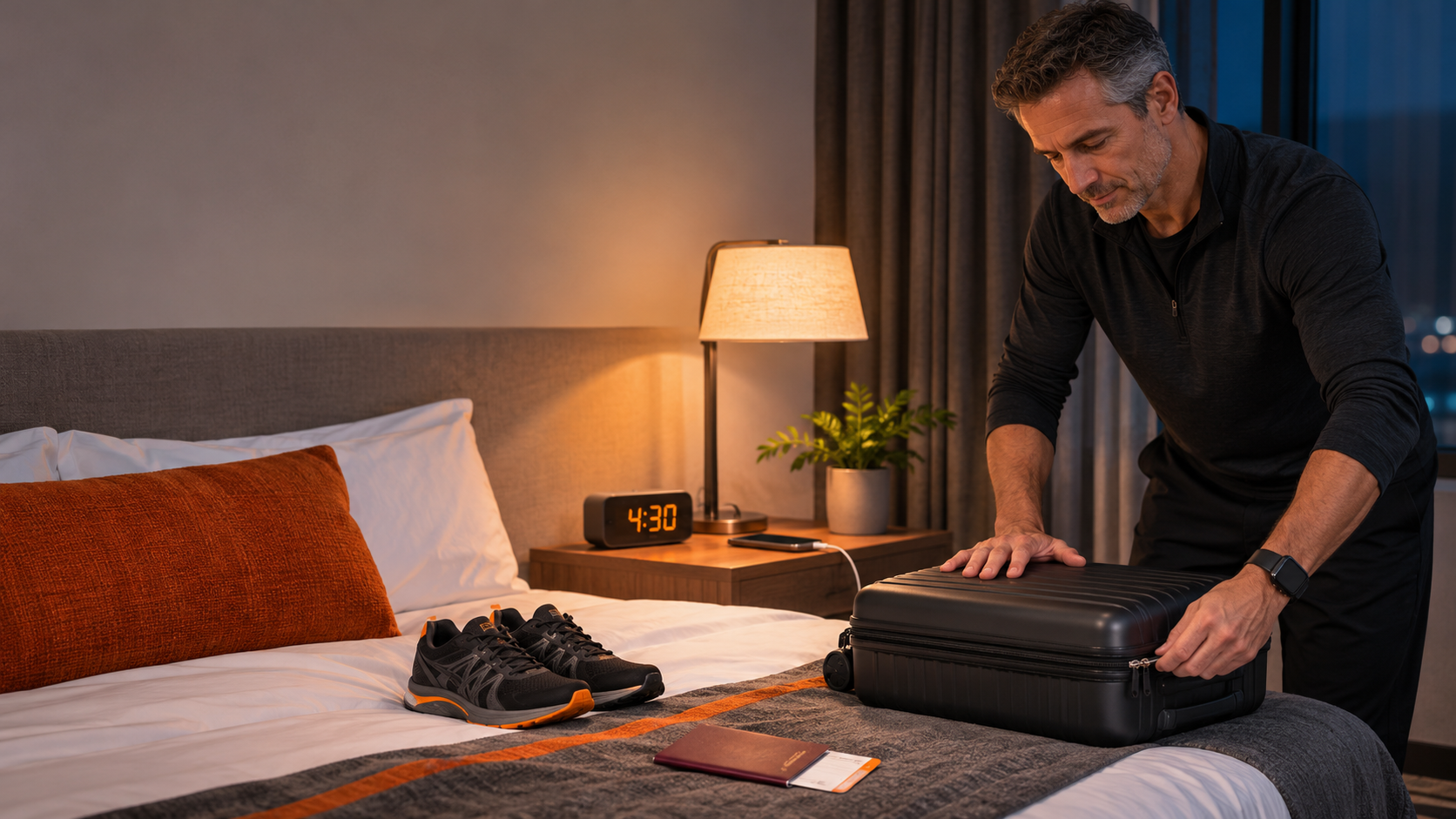
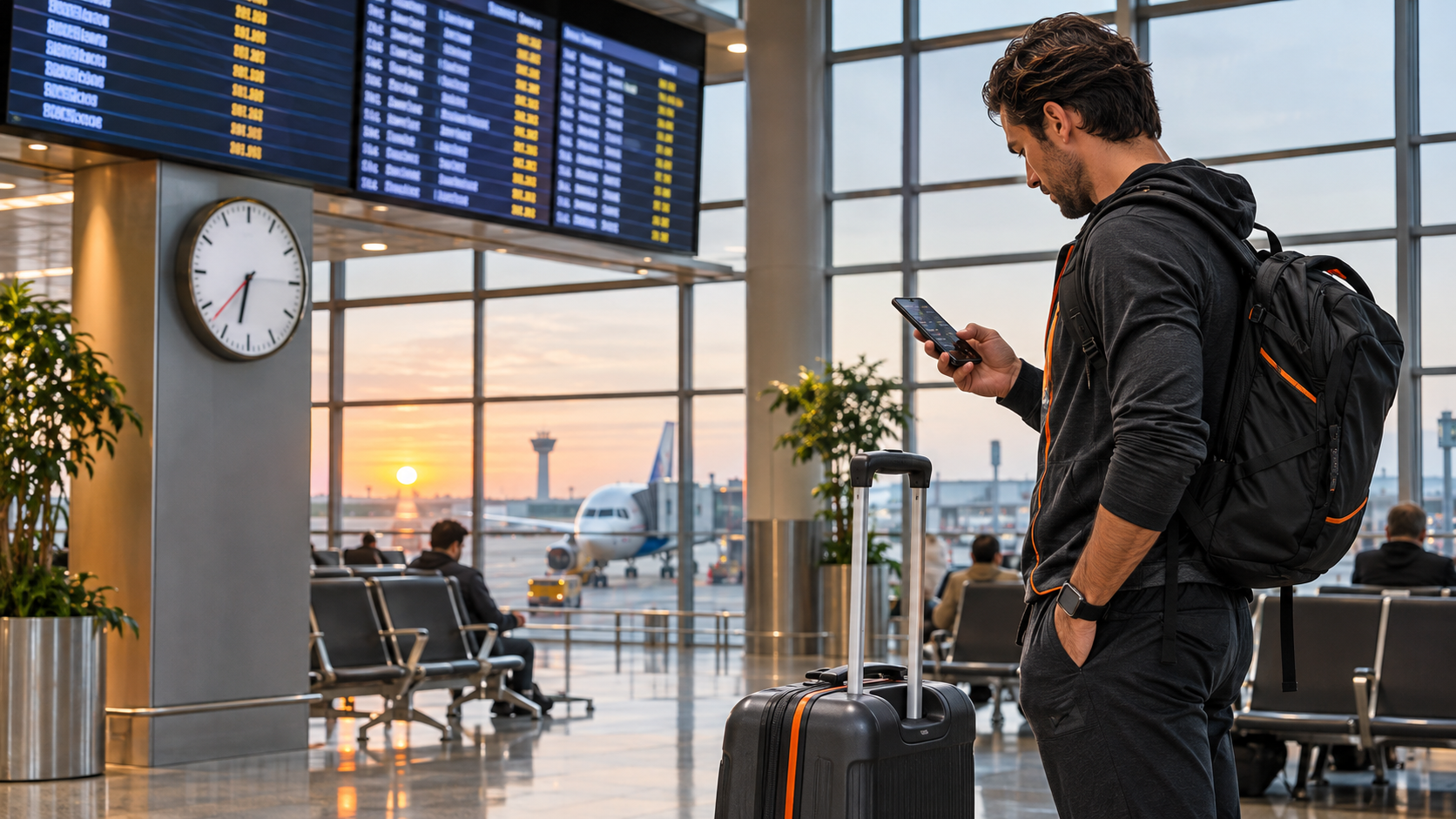
You arrive tired and must present at 2 p.m., but you also need hotel sleep at 9:30 p.m. A modest, known dose early enough to support the presentation may fit the plan. A large coffee immediately after the meeting does not. Once the performance window ends, switch to daylight, easy movement, food, and water, then protect the planned sleep opportunity.
If arrival fatigue is the larger problem, use the Arrival Ladder to separate travel fatigue from circadian jet lag and choose the first workout accordingly.
The one-minute travel card
Add these four lines to your itinerary:
- Operating clock: home-clock bias, partial bridge, or destination shift.
- Protected sleep: the next realistic sleep start time.
- Performance window: the hours caffeine is allowed to serve.
- Last caffeine: the written cutoff plus the replacement drink or action.
The goal is not to eliminate caffeine or engineer perfect sleep. It is to stop an unplanned afternoon dose from creating a second problem after the first problem—travel fatigue—has already arrived.
Put the plan into practice
Free next step: Download the Fit to Travel 100-Day Action Companion, a free 134-page execution workbook with all 100 Field Orders, daily planning and action logs, minimum actions, reflection questions, workout tools, and ten-day checkpoints.
For the complete system for maintaining fitness, nutrition, and healthy habits on the road without requiring perfect conditions, see Fit to Travel.
About the author: Jeff Emblen is the author of Fit to Travel and a former U.S. Army Master Fitness Trainer. His Lean by Habit approach uses preparation, minimum effective actions, and repeatable routines to help fitness survive busy schedules and travel.

Leave a Reply