

The best time to protect tomorrow’s workout is the first five minutes after you enter the hotel room. Before you sit on the bed, answer four questions: What gear will I use? Where will I train? When will I start? What is the smallest version that still counts?
Travel removes the cues that normally start your routine. Your gym is gone. Meetings move. Dinner runs late. The bed is six feet away and has a strong closing argument. The Hotel-Arrival Rule rebuilds the cue before comfort and fatigue take over.
Why “I’ll work out tomorrow” is not a plan
Motivation is useful, but intention alone is unreliable. A 2026 systematic review and meta-analysis examined 89 randomized physical-activity trials involving 10,219 people. In the lower-risk-of-bias studies, most participants failed to achieve their activity goals at each measured time point, and achievement declined over time.
That review was not specifically about business travelers, so it cannot tell us how often a hotel workout will happen. Its practical warning is narrower: setting a goal is not the same as creating the conditions that make action likely.
A separate 2026 evidence overview on the intention–activity gap identified planning, self-monitoring, habit, identity, confidence, and expected enjoyment as important parts of turning exercise intentions into behavior. Lean by Habit translates that evidence into a travel rule: connect the workout to a predictable arrival cue and remove the next decision before the day gets complicated.
Run the four-part Hotel-Arrival Rule
1. Reveal the gear
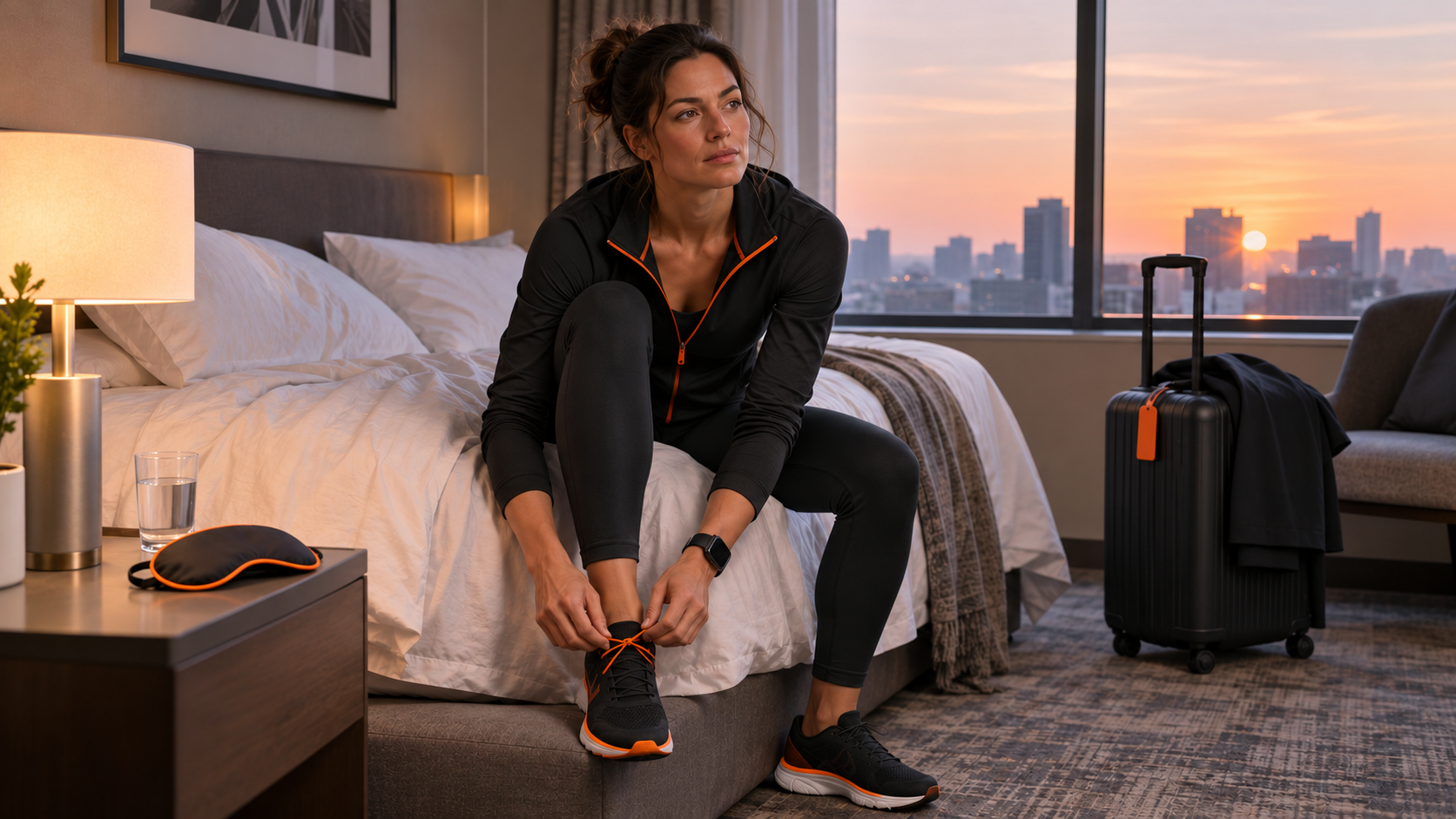
Take out your shoes, workout clothes, and any band or suspension trainer you brought. Put them where you will see them—not folded neatly at the bottom of the suitcase.
Visible gear is a prompt. It also removes a small but real barrier: searching, unpacking, and deciding what to wear when you are tired.
2. Decide the place
Inspect the hotel gym before committing to a workout that its equipment cannot support. If the gym is closed, crowded, or poorly equipped, choose open floor space, a resistance-band session, a safe walking route, or the stairs.
This is not lowering the standard. It is choosing a workable environment instead of letting the environment make the choice for you.
3. Anchor the start
“Tomorrow morning” is vague. Use a visible event:
- After the alarm, put on the staged clothes before checking email.
- Before breakfast, complete the planned session.
- After the final meeting, go directly to the gym before returning to the room.
Choose one anchor, not three competing possibilities. If your schedule changes, use the fallback plan below rather than renegotiating the entire day.
4. Create proof
Do two minutes of easy movement now: controlled squats, marching, mobility, band rows, or a short walk down the hall and back. This “ignition” is not the workout and should not be sold as equivalent to one. It is immediate proof that your training habit made the trip.
Lean by Habit decision rule: Do not ask tomorrow’s tired version of you to make decisions that today’s arriving version can settle in five minutes.
Choose Plan A, B, and C before you need them
The arrival rule works better when “work out” has more than one acceptable shape. Use this three-level plan:
Plan A: the full session
Complete the strength or conditioning workout already scheduled—typically 20 to 40 minutes—using the hotel gym, resistance bands, bodyweight movements, or a safe outdoor route.
Plan B: the minimum effective session
If the day compresses, use 10 minutes. Pick one push, one pull, one squat or split-squat pattern, and one core or carry pattern. Move with control and stop with your form intact. A band row can cover the pulling pattern when a hotel room offers no useful equipment.
Plan C: protect the pattern
If travel disruption makes even ten minutes unrealistic, complete the two-minute ignition and add a brief walk when safe. Plan C is not your long-term training dose. It is the bridge that keeps one disrupted day from automatically becoming several.
This hierarchy matches the practical message in the ACSM’s 2026 resistance-training update: consistency matters more than unnecessary complexity, and bands, bodyweight exercise, and home-based routines can produce meaningful benefits. ACSM still recommends progressively training the major muscle groups at least twice weekly for healthy adults. A travel fallback supports that larger plan; it does not replace progression.
Protect sleep and the workout with the same arrival cue
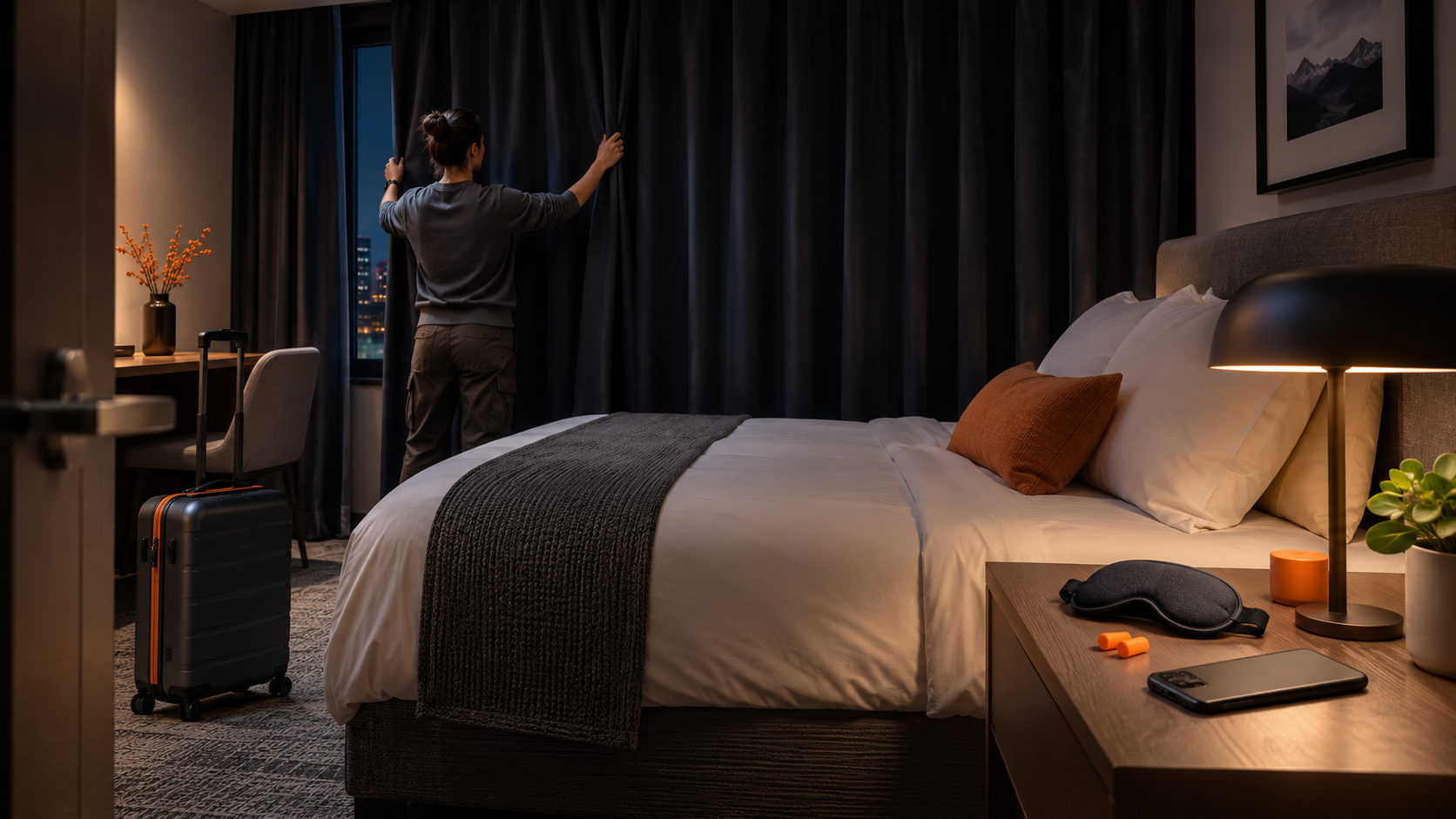
Workout setup is only half of a useful hotel arrival. Use the separate First-Five Room Reset to check noise, darkness, temperature, and your wind-down cue. Then stage your workout gear.
If the trip crosses time zones, decide whether the session should follow local time or remain closer to home time. The Short-Trip Clock Map helps you make that decision for a two-day trip.
Use the rule on your next trip
When the hotel door closes: reveal the gear, decide the place, anchor the start, and create two minutes of proof. Then write down Plan A, Plan B, and Plan C. The useful win is not a perfect travel week. It is a routine that knows what to do when the week is not perfect.
The free 134-page companion includes all 100 Fit to Travel Field Orders, daily planning and action logs, minimum actions, reflection questions, workout tools, and ten-day checkpoints. No purchase is required. For the complete system, Fit to Travel is available on Amazon.
Sources and limitations
- Swann et al., “The rates with which individuals fail versus achieve physical activity goals” (2026). This meta-analysis pooled structured physical-activity interventions; it did not test the Hotel-Arrival Rule.
- Rhodes and Brennan, “Closing the Gap Between Physical Activity Intentions and Sustained Behavior” (2026). This is an overview of evidence, not a hotel-specific intervention trial.
- American College of Sports Medicine, 2026 resistance-training guideline update. The guidance supports multiple training modes and regular participation; individual needs, experience, safety, and goals still matter.
Featured photo by Andrew Neel via Unsplash.


Leave a Reply