
Short answer: walking can support bone health after 40, especially when it is brisk enough to provide a meaningful training stimulus. But walking alone is not the complete plan. The most practical long-term approach combines regular weight-bearing activity with progressive resistance training and, as we get older, balance work.
A large review published in The BMJ on September 9, 2026 gives us a better way to think about this question. Researchers analyzed 124 randomized trials involving 18,429 adults age 40 and older. Brisk walking or jogging ranked favorably for bone mineral density at the lumbar spine, femoral neck, and total hip. Combined aerobic and resistance exercise also appeared useful at the lumbar spine.
That is encouraging. It is not permission to turn a single exercise into a miracle cure.
What the new research actually found
The review compared several forms of exercise, including resistance training, brisk walking or jogging, mixed aerobic exercise, mind-body exercise, and combined programs. Its clearest practical message was that exercise can help slow age-related losses in bone mineral density.
- Lumbar spine: brisk walking or jogging and combined aerobic-resistance exercise were among the more favorable options.
- Femoral neck: brisk walking or jogging and mind-body exercise ranked favorably.
- Total hip: brisk walking or jogging was the only modality that showed a favorable effect in the primary network analysis.
- Dose: the relationship was not simply “more is always better.” The authors reported a nonlinear, inverted-U pattern.
The dose-response modeling suggested that roughly 400 MET-minutes per week may be a useful threshold for the lumbar spine and around 600 MET-minutes per week for the femoral neck and total hip. The authors translated that into approximately two to three hours per week of brisk walking or jogging. However, the certainty of the evidence ranged from low to moderate, and those numbers should be treated as research estimates—not a universal prescription.
You can read the full PubMed abstract for the 2026 BMJ review.
Bone density is not the same as fracture prevention
This distinction matters. Bone mineral density is a useful marker, but fractures are the outcome people understandably care about most. Only 26 of the 124 trials reported fracture outcomes. Some exercise categories showed promising estimates, but the certainty was low and several comparisons were neutral.
So the fair conclusion is:
Exercise can help preserve bone density and improve the strength, balance, and physical function that influence fracture risk. The current evidence does not prove that one specific exercise routine will prevent fractures for every adult.
That is a less dramatic message than “this workout builds unbreakable bones,” but it is more useful.
Why ordinary walking may not be the whole answer
Walking is accessible, repeatable, and valuable for cardiovascular health. It also loads the skeleton because you are supporting your body weight. But the training stimulus depends on pace, terrain, current fitness, and what your body is already accustomed to doing.
A relaxed stroll is still worthwhile movement. It may not create the same bone-loading stimulus as brisk walking, hills, appropriately selected impact exercise, or progressive strength training. This is why the Bone Health & Osteoporosis Foundation recommends both weight-bearing and muscle-strengthening exercise rather than treating them as substitutes for one another.
The practical mistake is asking one activity to do every job. Walking does not have to replace strength training, and strength training does not have to replace walking.
The Lean by Habit Bone-Health Floor
The Lean by Habit approach is to protect the smallest repeatable pattern that covers the important jobs. For bone health, that means building a Bone-Health Floor before chasing specialized equipment or an elaborate program.
1. Keep a weight-bearing anchor
Use brisk walking, hills, stairs, jogging, or another appropriate upright activity as the activity you can repeat most weeks. The new review suggests brisk walking or jogging is a reasonable evidence-based option, but the appropriate level of impact depends on your joints, fall risk, and bone health.
2. Protect two strength opportunities
Adults should include muscle-strengthening activity at least two days per week under the federal Physical Activity Guidelines for Americans. A basic program can include a squat or sit-to-stand, hinge, push, pull, carry, and calf-focused movement, scaled to the individual.
If you need a starting point, see the Lean by Habit guide to strength training after 40 and the free training programs and habit trackers.
3. Add a small balance slot
Bone strength is only part of fracture prevention. Staying upright matters too. Older adults are advised to include multicomponent activity with balance, aerobic, and muscle-strengthening work. The recent Lean by Habit article on balance training after 60 shows how to add a short, supported balance slot without turning it into another full workout.
A weekly pattern that survives real life
The point is not to hit a perfect calendar. It is to keep the pattern alive when the week changes.
| Version | Weight-bearing work | Strength | Balance |
|---|---|---|---|
| Ideal | Three brisk walks or similar sessions | Two full-body sessions | Three short slots |
| Compressed | Two shorter brisk walks | Two abbreviated sessions | Two short slots |
| Minimum | One purposeful walk | One basic full-body session | One supported slot |
| Return | Resume the next planned session | No punishment workout | Restart with the easiest safe version |
These examples are behavior targets, not a medical treatment plan. The dose that is safe and appropriate depends on your health, training history, and fracture risk.
Should you add a weighted vest?
Not automatically.
A 2026 meta-analysis of nine randomized trials and 368 participants found that weighted-vest exercise produced favorable results compared with usual activity for some bone-density measures. But when a vest was compared with the same exercise without a vest, the additional bone-density benefit was not statistically significant—and that comparison came from only one study. Overall certainty was low to moderate for most bone outcomes.
Read the weighted-vest review on PubMed.
The Lean by Habit rule is simple: do not add load to compensate for an unstable habit. First establish the walking and strength pattern. Then consider a vest, hills, or other progression only if it is safe, tolerable, and improves the training stimulus without making consistency worse.
If you want to understand weighted walking more broadly, see the evidence review on rucking and fitness.
Who should get individualized guidance first?
Talk with a clinician or qualified physical therapist before adding impact, heavy resistance, or a weighted vest if you have diagnosed osteoporosis or osteopenia, a prior fragility fracture, significant back or joint pain, poor balance, recurrent falls, or another condition that changes exercise safety.
The Bone Health & Osteoporosis Foundation advises people at high fracture risk to work with a physical therapist on a safe program and cautions that certain high-impact, rapid-twisting, and loaded forward-bending movements may be inappropriate for some people.
Screening is a separate issue from exercise. The U.S. Preventive Services Task Force recommends osteoporosis screening for women age 65 and older and for younger postmenopausal women at increased fracture risk. Evidence remains insufficient for a broad screening recommendation in men. A clinician can help interpret how those recommendations apply to your risk factors.
The useful answer
Walking is not “just cardio.” Brisk, regular walking can be part of a legitimate bone-health strategy after 40. The new 124-trial review strengthens that case.
But the best habit is not walking instead of strength training. It is a weekly system that keeps weight-bearing activity, resistance training, and balance work in the picture—at a dose you can recover from and repeat.
Your next step: choose one weight-bearing anchor and schedule two strength opportunities for the coming week. Then use the free Lean by Habit Habit Tracker and Scorecard to score whether you protected the pattern, not whether the week was perfect.
For a broader system built around repeatable fitness habits, visit the Lean by Habit books page.
This article is educational and is not a diagnosis or individualized treatment plan. Exercise recommendations should be adapted to your health, fracture risk, medications, symptoms, and clinical guidance.
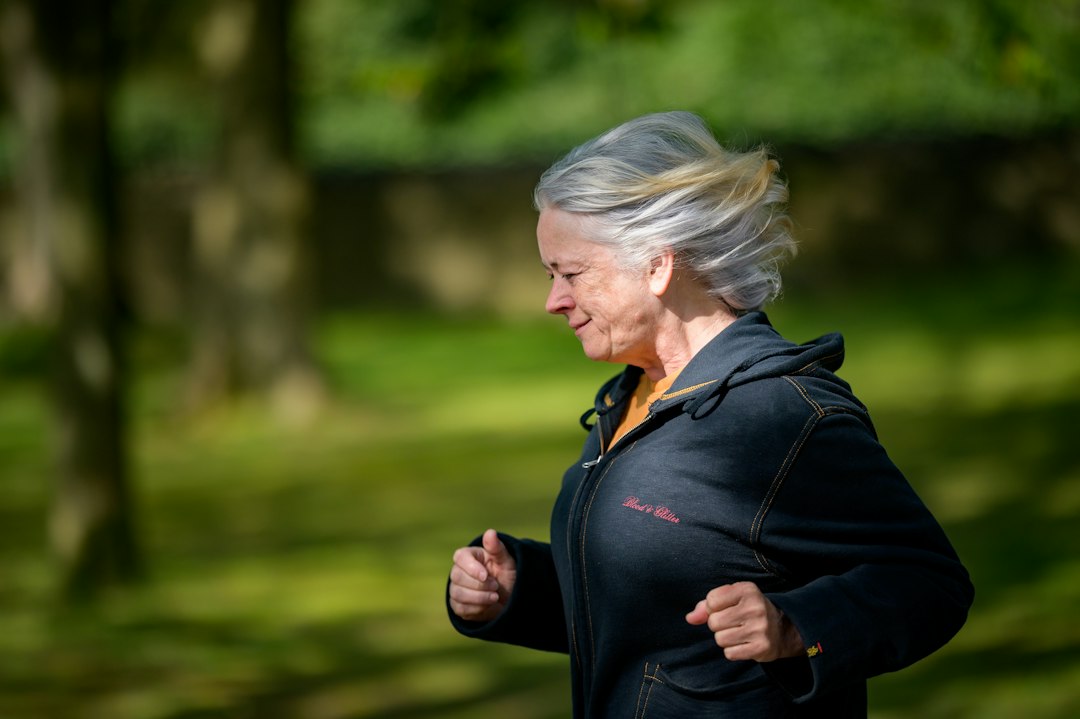
Featured photo by Centre for Ageing Better on Unsplash.


Leave a Reply