
Strength training is essential after 60, but it is not a complete substitute for balance practice. Stronger legs give you more capacity to recover from a misstep. Balance also depends on how quickly you sense a change, organize your body, shift your weight, and take an effective step. Those are skills—and skills improve when you practice the task itself.
A large 2026 review of 423 randomized trials and 33,901 adults aged 60 or older found that 18 of 19 exercise categories improved overall balance compared with control conditions. The important detail was that different activities appeared to emphasize different parts of balance. The researchers also cautioned that their rankings did not prove one method was universally superior.
The practical Lean by Habit answer is simple: keep strength training, then reserve a small, repeatable Balance Slot for the skill your normal workout may miss.
Why strength helps—but does not cover every balance demand
Balance is not one quality. Standing still on one leg, walking on an uneven surface, changing direction, and recovering after a stumble are related but different problems.
Resistance training can improve the force available to stand, climb, step, and catch yourself. Squats, split squats, step-ups, calf raises, and loaded carries also challenge posture and coordination. That makes strength a valuable foundation.
But a supported leg press does not ask the same question as a narrow stance, a controlled step in a new direction, or a quick response to an unexpected shift. The new review found only tentative reactive-balance signals for conventional resistance training, while balance-specific and movement-specific methods showed different patterns across balance domains.
That does not make strength training less important. It means the most complete approach combines strength with deliberate balance practice—the same reason the broader five components of fitness include neuromotor fitness rather than treating strength as the answer to everything.
What the 423-trial review actually found
The review compared exercise types across several balance domains. These are not interchangeable labels:
| Balance demand | What it looks like in real life | Methods with favorable estimates in the review |
|---|---|---|
| Static balance | Holding a position without excessive sway | Supervised perturbation training |
| Global balance | Broad performance across several balance tests | Tai Chi |
| Dynamic balance | Controlling the body while moving | Pilates |
| Proactive balance | Preparing for a planned movement or obstacle | Agility stepping and aquatic exercise |
| Home-based balance | Using sensory and position challenges in a practical setting | Sensory training |
These findings are useful, but they are not a shopping list of mandatory classes. Network meta-analysis combines direct and indirect comparisons across many studies. It can identify patterns, but differences in programs, supervision, participants, and outcome tests make the rankings less certain than a simple “best exercise” headline suggests.
The dose-response findings were also nonlinear and exploratory. In plain language, the study does not give us one proven number of minutes that everyone should perform. Task-specific challenge, safety, access, and repeatability still matter.
The Lean by Habit Balance Slot
A balance program fails if it is ambitious enough to impress you but inconvenient enough to disappear. The Balance Slot uses four familiar Lean by Habit ideas: attach the practice to an existing trigger, start with a minimum dose, shape the difficulty gradually, and score completion rather than perfection.
- Trigger: Place the Balance Slot immediately after your warm-up, before fatigue, or after a dependable daily cue such as brushing your teeth.
- Minimum: On a chaotic day, perform one safe stance and one controlled stepping drill for two minutes.
- Standard: Complete the five-minute routine below three times per week.
- Progression: Change only one variable at a time—less hand support, a narrower stance, a slower tempo, a longer hold, or a more precise step.
- Score: Record whether you completed the slot. Do not turn every wobble into a verdict on your fitness.
This is skill practice, not a test you pass or fail. A small amount of high-quality practice can coexist with the two-day strength habit that supports muscle, function, and cognitive health.
A safe five-minute balance routine
Use a sturdy counter or heavy chair that will not slide. Clear the floor and stay close enough to use your hands immediately. The goal is mild challenge with control—not proving that you can rescue a bad position.
| Minute | Practice | How to scale it |
|---|---|---|
| 1 | Supported weight shifts: move slowly left to right and forward to back | Keep both hands on support; progress to fingertips |
| 2 | Staggered or tandem stance: one foot partly or fully in front of the other | Widen the stance if needed; narrow it gradually |
| 3 | Supported single-leg stand: alternate sides | Use the support needed to stay controlled |
| 4 | Clock steps: step forward, sideways, and diagonally, then return | Shorten the reach before reducing support |
| 5 | Sit-to-stand or low step-up: finish with a functional strength pattern | Raise the chair or use hand assistance as needed |
Performing this routine three times per week creates a small but deliberate balance practice. It is not a clinical fall-prevention program, and it is not designed to imitate laboratory perturbation training. Unexpected pushes, unstable devices, eyes-closed drills, and rapid direction changes can raise risk and are better introduced with qualified supervision when appropriate.
How to fit balance into a busy week
You do not need a separate 45-minute “balance day.” Use one of these placements:
- Before two strength workouts: five minutes after the warm-up, while attention and coordination are fresh.
- At a daily anchor: a supported stance after brushing your teeth or while waiting for coffee.
- As active recovery: Tai Chi, controlled walking patterns, or an appropriate class on a non-lifting day.
The weekly target is not “perfect balance.” It is repeated exposure to safe, progressively challenging tasks. Your strength program builds capacity. Your Balance Slot teaches you to use that capacity in more positions and movement patterns.
When a home routine is not enough
The U.S. Preventive Services Task Force recommends exercise interventions for community-dwelling adults 65 or older who are at increased risk of falls. The most common programs combine gait, balance, and functional training, often with strength work. That recommendation applies specifically to people at increased risk, not automatically to every adult.
Seek individualized guidance from a healthcare professional or physical therapist if you have fallen recently, feel unsteady during normal walking, have unexplained dizziness, use a mobility aid, have a neurological or vision condition affecting balance, or cannot perform basic practice safely beside stable support. Falls are not always just a fitness problem; medication, blood pressure, vision, footwear, pain, and the home environment can also matter.
The practical takeaway
Strength training after 60 is a foundation, not the entire balance plan. Keep building leg and trunk strength. Then add a small dose of stance, weight-shift, and stepping practice that is safe enough to repeat.
The Lean by Habit rule is: build strength, practice the skill, and progress the challenge without progressing the risk.
Your next step
Choose one trigger for your first two-minute Balance Slot today. Then use the free Lean by Habit Habit Tracker and Scorecard to score the behavior for one week. For the broader system behind triggers, shaping, scoring, and minimum-dose routines, visit the Lean by Habit Books page.
Sources
- Wang J, et al. Exercise modalities for overall and domain-specific balance performance in older adults: a systematic review and Bayesian network meta-analysis. Ageing Research Reviews. 2026;121:103303.
- Liu Q, et al. Effects of task-oriented training on balance, gait, and fall in older adults: a systematic review and meta-analysis. 2026.
- U.S. Preventive Services Task Force: Falls Prevention in Community-Dwelling Older Adults—Interventions. June 2024.
- CDC: Older Adults—Adding Activity Recommendations.
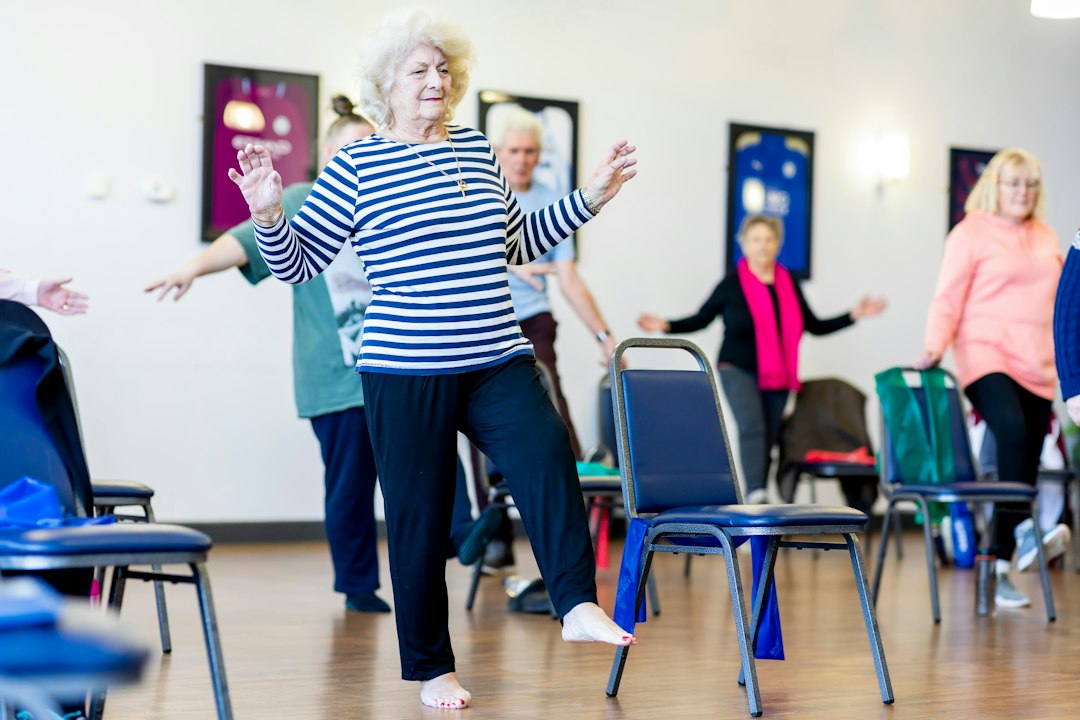
Featured photo: Centre for Ageing Better / Unsplash.
This article is educational and does not replace individualized medical or physical-therapy advice.
By Jeff Emblen, author of Lean by Habit.


Leave a Reply