
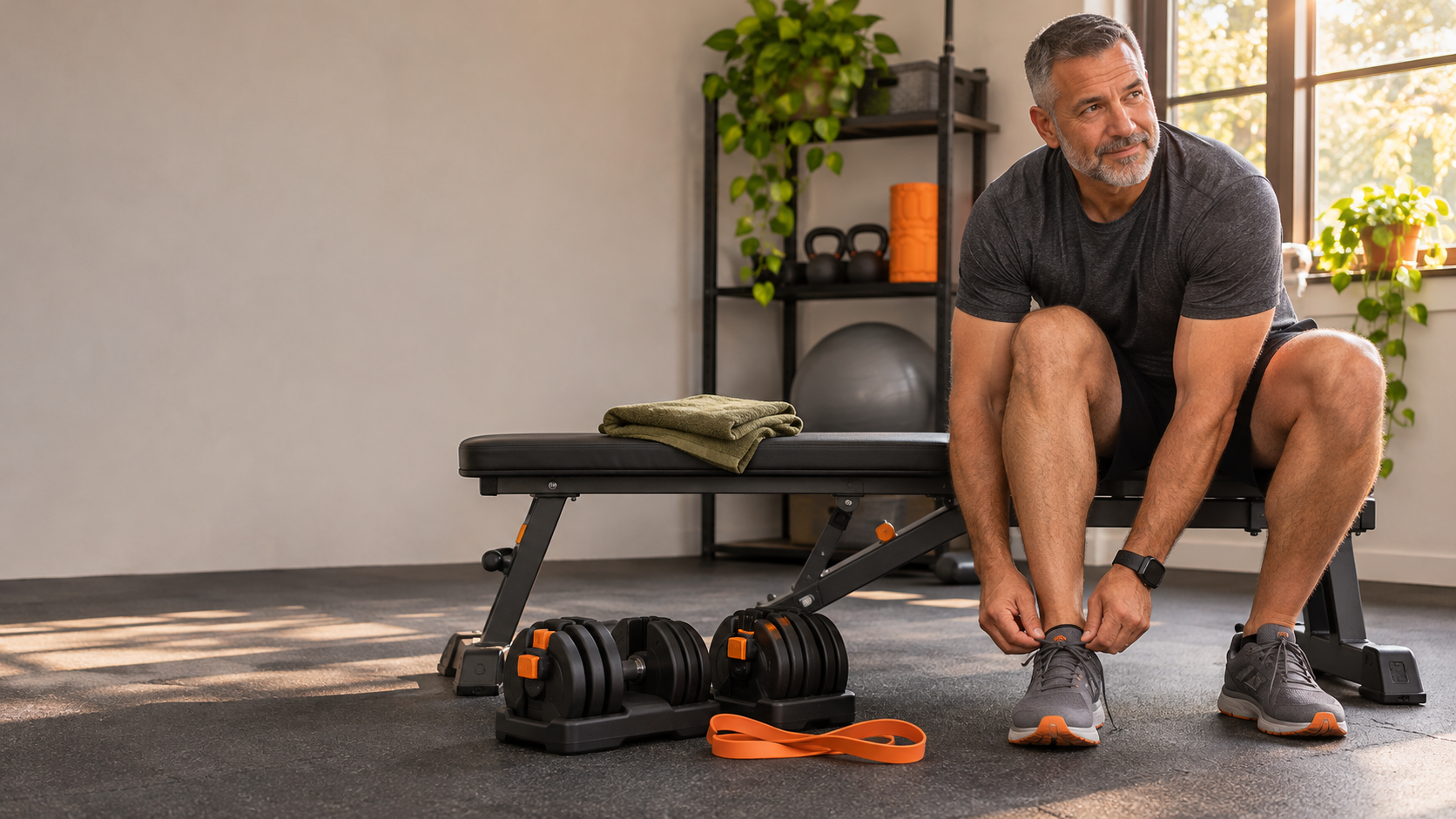
The short answer: do not try to recreate your last military fitness test. Build a new baseline around your current health, schedule, and goals—then protect it with a minimum version you can still complete on difficult weeks.
Leaving active service changes more than a calendar. The mandatory schedule, unit accountability, shared mission, and built-in reason to train may disappear at the same time. The body may also be older, carrying an injury, or managing a condition that was not part of the equation during earlier training.
That makes “getting back in shape” the wrong first mission. A better mission is to build a routine that fits the life and body you have now.
Jeff Emblen, author of Fit to Travel and a former U.S. Army Master Fitness Trainer, built Lean by Habit around a practical idea: proven training only works when the actions are repeatable. Applying that principle to fitness after military service means replacing all-or-nothing tests with a current-capacity plan, a fallback dose, and a weekly review.
The fitness test ended. The need for a system did not.
Military training has a clear standard and an external structure. Civilian fitness often has neither. It is easy to compare today’s session with an old score, an old bodyweight, or what the whole unit once did together. That comparison can turn a sensible restart into punishment.
Your old performance can be part of your history without being today’s entry requirement. The useful question is not, “What could I do then?” It is, “What dose can I recover from and repeat now?”
The Department of Veterans Affairs gives similarly flexible guidance: avoid inactivity, start at a comfortable level, increase gradually, and choose activities you enjoy. The long-term target for most adults remains at least 150 minutes of moderate aerobic activity per week plus strength work on two days—but the VA also makes the crucial point that any amount of activity is better than none.
What veteran-specific research suggests
A systematic review of stepped-down physical-activity programs for military veterans found that 54% of the included studies reported a positive between-group effect on activity. The techniques used most often were education, goal setting, goal review, and self-monitoring.
That finding is useful, but it is not a guarantee. The review covered 26 studies representing 17 programs, all from the United States, and the reported increase in activity relied largely on self-reported measures. The evidence says structured behavior tools can help; it does not prove that one template fits every veteran.
Technology is not a substitute for the system, either. In a 12-month randomized trial of 357 veterans, adding brief coaching to a wearable-and-app program did not improve activity compared with the app alone. Activity declined in both groups, and roughly two-thirds of participants were no longer syncing their trackers at 12 months. The authors concluded that long-term adherence and engagement were difficult to sustain.
The Lean by Habit translation is straightforward: a device can record the mission, but it cannot make the mission livable. The plan still needs a realistic dose, a cue, and a way to recover after disruption.
The Current-Mission Reset
This is a five-part application of established Lean by Habit principles—minimum effective action, progressive training, self-monitoring, and fast recovery after a miss—to the transition from military to civilian fitness.
1. Define what fitness must do for you now
Choose one six-to-eight-week mission based on present life, not past identity. Examples include:
- Walk for 30 minutes without a pain flare.
- Complete two full-body strength sessions each week.
- Rebuild enough work capacity for hiking, travel, or playing with grandchildren.
- Improve energy and consistency before pursuing a body-composition goal.
A specific mission makes “get fit” measurable without turning every session into a test.
2. Establish a two-week baseline
For two weeks, record what you actually complete: session type, minutes, effort, and how you feel the next day. Do not use the baseline period to prove toughness. Use it to find a dose you can recover from.
If you need a simple effort scale, use the Lean by Habit Four-Lane Effort Map. Most restart sessions belong in the “steady” lane: purposeful work that leaves room for another repetition or a few more minutes.
3. Build three versions of the week
A sustainable plan should survive more than ideal conditions. Decide in advance what you will do on a normal week, a compressed week, and a difficult week.
| Week | Strength | Aerobic work | Win condition |
|---|---|---|---|
| Full | Two full-body sessions | Three brisk walks or other moderate sessions | Complete the planned week |
| Compressed | Two 20-minute sessions | Two 15-minute walks | Keep both training categories alive |
| Minimum | One circuit of four movements | One 10-minute walk | Protect the habit and schedule the return |
The minimum week is not the goal. It is the bridge that prevents a disrupted week from becoming a lost month. If you want help designing a fallback, start with the Minimum Viable Habit.
4. Use broad movement categories, not a nostalgia workout
A simple full-body session can cover five categories: a squat or sit-to-stand, a push, a hinge, a pull, and a carry or core exercise. Bands, dumbbells, machines, and bodyweight can all work.
The American College of Sports Medicine’s 2026 position stand synthesized 137 systematic reviews involving more than 30,000 participants. Its practical message was that moving from no resistance training to some resistance training produces the most important gain, and that individualization matters more than rigid complexity. Home-based work, elastic bands, and bodyweight training can all improve strength and function. For healthy adults, training major muscle groups at least twice weekly is a sound target, but the plan should fit the person.
During a restart, choose variations you can perform comfortably and stop most sets with two to four good repetitions still available. Progress one variable at a time: repetitions, load, range of motion, or minutes. This is training, not a selection event.
5. Score the return, not just the streak
At the end of each week, answer four questions:
- How many planned sessions did I complete?
- What cue reliably started the session?
- What interfered with the plan?
- What is the next scheduled action?
The fourth question matters most after a miss. The Recovery-Speed Rule treats the return as a skill. You do not erase the miss or punish it with double volume; you shorten the gap between the miss and the next useful action.
A practical first week
If you are medically ready to exercise but have been inconsistent, a first week could look like this:
- Monday: 20–30 minutes of full-body strength at a steady effort.
- Tuesday: 15–20 minutes of walking at a pace that still allows conversation.
- Thursday: repeat the strength session or use easier variations.
- Saturday: 20–30 minutes of walking, cycling, swimming, or another comfortable aerobic activity.
- Every session: log minutes, effort, and next-day response.
That may be below the long-term public-health target, and that is acceptable at the start. Federal guidance explicitly recommends that inactive adults begin with small amounts and build toward 150–300 minutes of moderate activity plus two strength days. Starting small may improve the chance of sticking with it. See the current Physical Activity Guidelines questions and answers.
When to involve your VA care team
This article is general education, not an individualized exercise prescription. Talk with your healthcare team before increasing activity if you have chest pain or pressure, dizziness, concerning joint pain, an unstable chronic condition, or uncertainty about a service-connected injury.
VA resources can add structure without forcing a one-size-fits-all program. Whole Health coaching supports veteran-defined goals and self-management strategies. For eligible older veterans, Gerofit provides personalized exercise guidance through trained staff at participating VA systems and, in some locations, telehealth.
Your next action
Do not wait for the perfect restart. Choose your minimum week, put the first session on the calendar, and record what happens.
Free tool: Visit the Lean by Habit Program Downloads for a habit tracker, scorecard, example training log, minimalist programs, and other practical resources you can use to build and review your routine.
If travel regularly disrupts your training, Fit to Travel applies the same repeatable-action approach to maintaining fitness, nutrition, and healthy habits without a perfect gym or schedule.
About the author: Jeff Emblen is the author of Fit to Travel and a former U.S. Army Master Fitness Trainer. He enlisted as an infantryman, later attended the United States Military Academy at West Point, and served as an Armor Officer. Lean by Habit combines behavior-change tools with progressive training so fitness can survive real life.



Leave a Reply