
By Jeff Emblen
Sleep advice has become a crowded business. Darken the room. Cool the bedroom. Track your readiness score. Buy a new supplement. Optimize the last 90 minutes of the day.
Some of that can help. But there is a more basic question worth asking first: what did you do during the day?
A new 2026 study adds an interesting piece to that question. Researchers found that a 12-week resistance-training program improved objective sleep efficiency and total sleep time in a small group of older adults. That does not mean lifting weights is a treatment for insomnia. It does reinforce a broader Lean by Habit principle: before adding another optimization layer, make sure the foundational behaviors are actually in place.
The new research: promising, but not permission to oversell
A study published September 9, 2026 in GeroScience examined 36 community-dwelling adults ages 64 to 81. The training group performed explosive lower-body resistance exercise three times per week for 12 weeks while a control group maintained its lifestyle. The researchers reported improvements in objectively measured sleep efficiency and total sleep time, along with changes in sensorimotor lactate concentration.
That is interesting, especially because sleep tends to become more fragmented with age. But this was a modest study, and it should not be turned into a claim that lifting weights will fix sleep. It cannot establish that the same protocol will produce the same result in every adult over 50, and people with persistent sleep problems may need medical evaluation.
Read the 2026 GeroScience study.
The more useful takeaway is behavioral: sleep is not only a nighttime project.
The Lean by Habit approach: build upstream before optimizing downstream
One of the easiest ways to make health harder than it needs to be is to optimize the edges while neglecting the center. We debate the perfect supplement while protein intake is inconsistent. We compare recovery devices while training happens sporadically. We redesign a bedtime routine while the body has barely moved all day.
Lean by Habit works in the opposite direction. Start with the behavior that produces the largest return and make it repeatable. Only then add complexity.
For sleep and healthy aging, resistance training deserves a place near the foundation because its potential value extends well beyond sleep. Strength training supports muscle, physical function and independence as we age. A 2026 systematic review and meta-analysis of 13 randomized trials involving 546 older adults with sarcopenia found improvements in grip strength, gait speed, skeletal muscle index and five-times sit-to-stand performance with resistance exercise.
Read the 2026 resistance-training meta-analysis.
In other words, even if the sleep benefit turns out to be smaller or more variable than the new study suggests, strength training still has a strong reason to stay on the calendar.
Use a training floor, not a perfect program
The trap is turning strength training may support sleep into another demanding prescription. Three perfect workouts become the new requirement. A busy week arrives. The plan breaks. Then nothing happens.
A better system is to establish a training floor: the smallest version of the behavior that still keeps your identity and routine intact.
- Standard day: complete the planned 30 to 45 minute strength session.
- Compressed day: perform 15 to 20 minutes built around a squat, hinge, push and pull.
- Minimum day: complete one or two deliberate sets of several major movements rather than skipping the session entirely.
- Missed day: return at the next planned opportunity. Do not punish yourself with a double workout.
This is not an argument that every tiny workout produces the same physiological adaptation as a complete program. It does not. The purpose of the minimum version is behavioral: protect the pattern when life attacks the plan.
That is the same principle behind the Minimum Viable Habit and the Never Miss Twice Rule.
Do not turn strength training into another sleep score
There is an important psychological distinction here. Train because strength, muscle and physical capability matter. Treat better sleep as a possible additional benefit, not another nightly test you have to pass.
If you start checking your wearable every morning to determine whether yesterday’s squats worked, you have simply replaced one form of overthinking with another.
Score the behavior instead: Did I complete the strength session I planned?
That is controllable. Tonight’s exact sleep efficiency percentage is not.
A simple weekly strength-and-sleep framework
If you are currently inconsistent, resist the urge to jump straight into an elaborate five-day split. Start with two full-body sessions on days you can repeat reliably. Build around fundamental movement patterns and gradually progress the load, repetitions or difficulty.
Once two sessions are stable, a third can be added if it improves your program rather than making the routine fragile. The goal is not to collect workouts. The goal is to accumulate months and years of useful training.
Pair that daytime foundation with sensible sleep basics: a reasonably consistent sleep schedule, a dark and comfortable room, appropriate caffeine timing, and enough time in bed. Exercise is one contributor to sleep health, not a substitute for evaluating persistent insomnia, sleep apnea or other sleep disorders.
For a broader strength framework, see The Muscle Insurance Habit and The 2-Hour Strength Prescription.
The takeaway
The newest research on resistance training and sleep is encouraging, but the strongest lesson is not that you need a special sleep workout. It is that health behaviors interact, and foundational habits often solve more than one problem at a time.
Before buying another sleep gadget or adding another optimization ritual, ask a simpler question: Am I consistently doing the basic things that make me stronger, healthier and more resilient?
If strength training is missing, start there. Make the first version small enough to repeat. Score the behavior. Progress when consistency earns it.
That is less exciting than another sleep hack. It is also much harder to sell in a bottle.
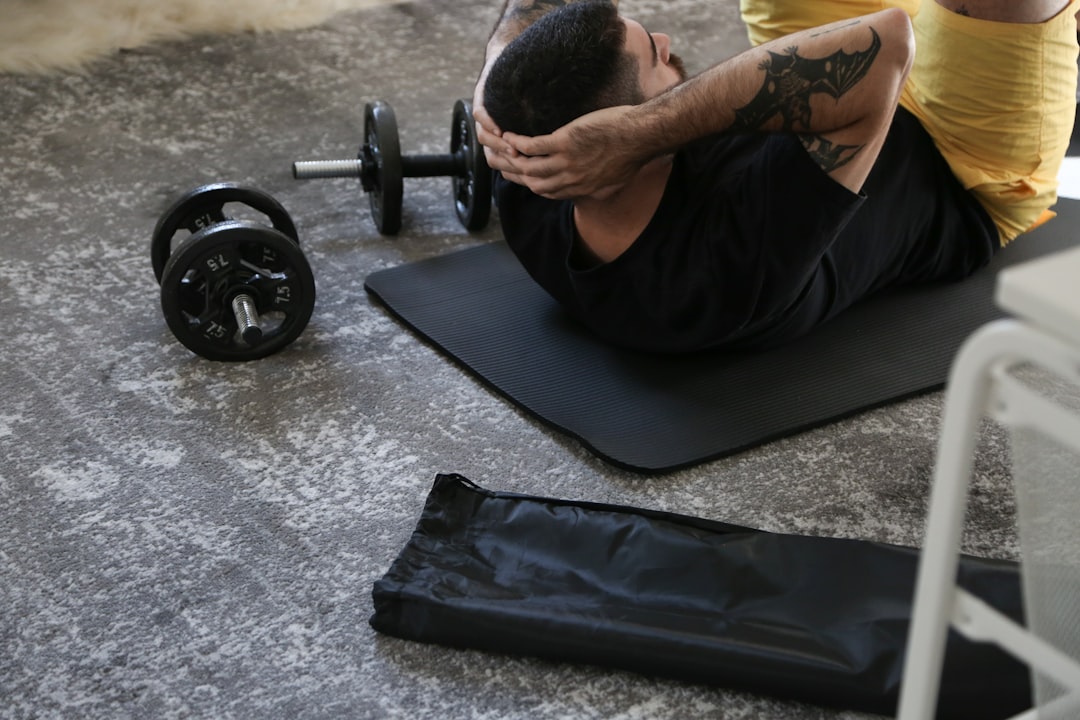
Photo by Giorgio Trovato on Unsplash.
Ready to make fitness easier to sustain? Explore more practical systems and free resources at Lean by Habit Free Downloads.


Leave a Reply