
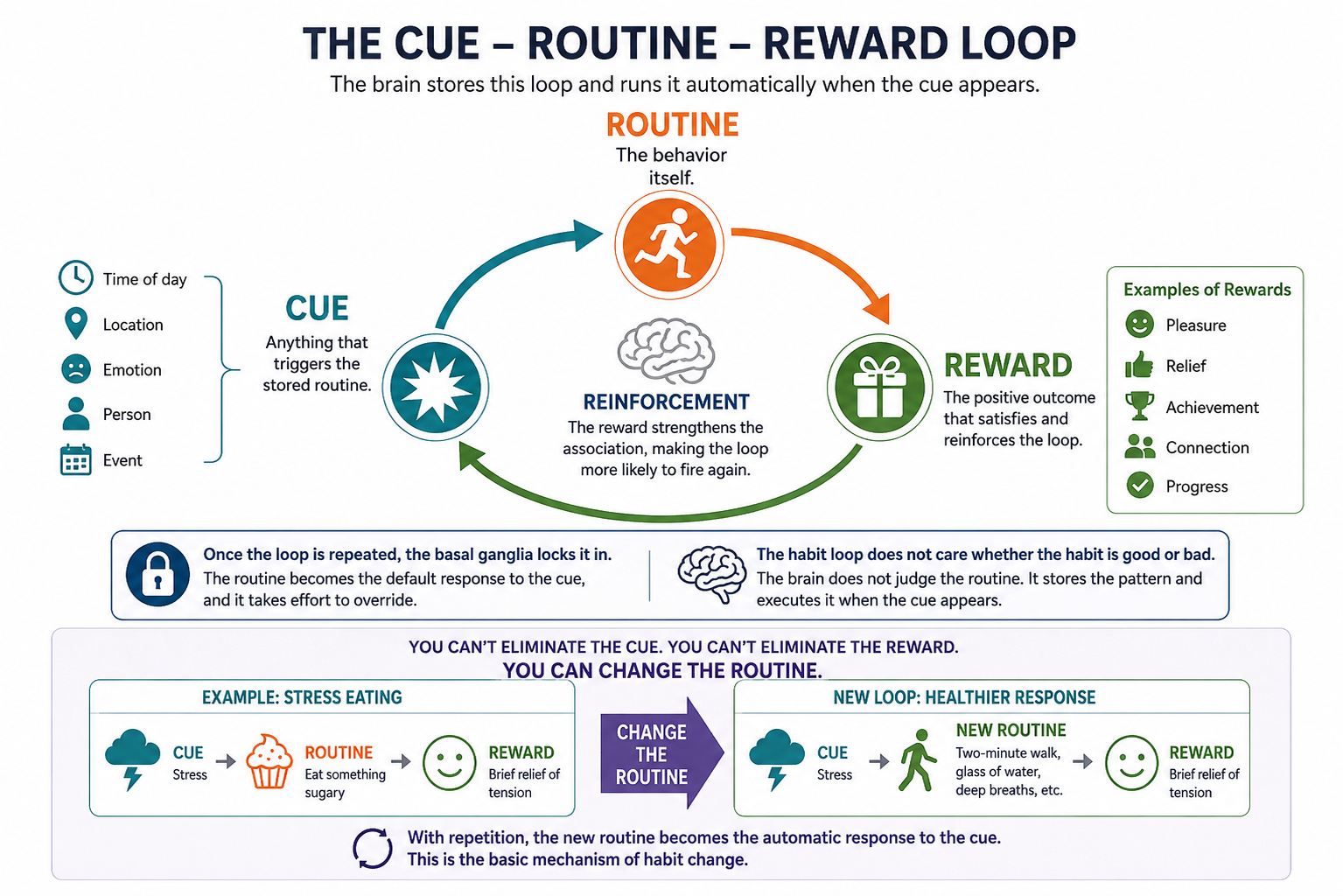
Most people try to change their behavior by focusing almost entirely on motivation. They tell themselves to exercise more, eat better, stop snacking, or get to bed earlier. That can work for a few days. Then life gets busy and the old pattern returns.
A more reliable approach is to understand the system underneath repeated behavior. One of the simplest models is the habit loop: cue, routine, and reward. Once you can see the loop, you can redesign it.

What Is the Habit Loop?
The habit loop has three practical parts. The cue tells your brain it is time to act. The routine is the behavior itself. The reward gives your brain a reason to remember the pattern and repeat it.
- Cue: a time, place, emotion, preceding action, or other trigger.
- Routine: the behavior that follows the trigger.
- Reward: the immediate benefit that reinforces the behavior.
The important point is that habits do not exist in isolation. They are connected to what happens immediately before and after them.
Step 1: Make the Cue Obvious
Vague intentions create inconsistent behavior. “I will work out more” forces you to make a new decision every day. A specific cue removes that decision.
Try attaching a healthy behavior to something that already happens reliably: After I pour my morning coffee, I will drink a glass of water. After lunch, I will walk for 10 minutes. When I leave work, I will go directly to the gym.
This works especially well with the 10-Minute Walk Habit, because the routine is simple enough to attach to lunch, dinner, or another predictable part of the day.
Step 2: Make the Routine Easy to Start
The best routine is not the most ambitious one. It is the one you can repeat. Lower the activation energy required to begin.
- Put your walking shoes by the door.
- Prepare tomorrow’s protein before you get hungry.
- Keep your workout clothes packed and visible.
- Set a minimum workout you can complete even on a difficult day.
- Remove tempting foods from the places where you see them most often.
This is environmental design in action. As explained in Habit Friction, reducing friction around good behaviors makes them more likely to happen.
Step 3: Give the Habit an Immediate Reward
Many worthwhile behaviors have delayed benefits. One workout does not transform your body. One healthy meal does not dramatically change your health. Because the payoff is distant, create a small immediate signal of success.
Check the habit off on a calendar. Track the workout. Enjoy a favorite podcast during your walk. Take a moment to recognize that you kept the promise you made to yourself. The reward does not need to be large. It needs to make completion feel satisfying.
Use the Same Loop to Break an Unwanted Habit
Do not simply fight the routine. Identify the cue and the reward first. If you snack every evening, ask what happens immediately beforehand and what you are actually seeking. Hunger? Stress relief? Entertainment? A break?
Then experiment with a replacement routine that responds to the same cue and delivers a similar reward. Changing the middle of the loop is often easier than trying to eliminate the entire pattern through willpower.
The 5-Minute Habit Loop Audit
Choose one behavior you want to improve and answer these five questions:
- What exactly is the behavior I want to repeat?
- What reliable event will cue it?
- How can I make the routine easier to start?
- What immediate reward will reinforce completion?
- What will I do if I miss once?
For the last question, use the Never Miss Twice rule. A strong system includes a recovery plan because perfect execution is not required for long-term success.
Build the System, Then Let Repetition Work
You do not need more heroic bursts of discipline. You need a repeatable loop that makes the right behavior easier to initiate and satisfying to complete.
Pick one habit today. Define its cue. Simplify its routine. Choose its reward. Then repeat.
That is the Lean by Habit approach: make healthy behavior practical enough to survive real life, then allow consistency to do the heavy lifting.



Leave a Reply