
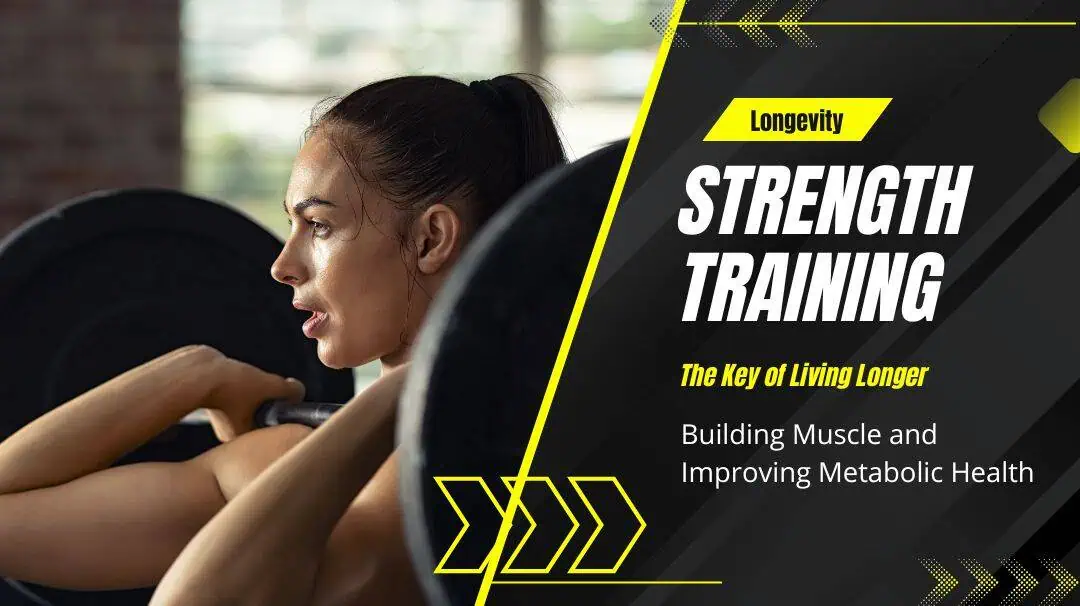
How much strength training do you need for longevity? For most healthy adults, two repeatable full-body sessions per week is a strong default. Cover the major movement patterns, use enough resistance to make the final repetitions challenging, progress gradually, and keep the program simple enough to continue for years.
Strength training cannot promise a longer life. What it can do is improve strength, muscle, power and physical function—the capacities that help you keep climbing stairs, carrying groceries, getting off the floor and living independently as you age.
The Lean by Habit view: Longevity training is not a short, punishing campaign. It is a strength habit that survives busy seasons, travel, imperfect equipment and changing ability. Build a durable floor first; optimize only after the floor is reliable.
What the longevity evidence really shows
A systematic review and meta-analysis of 16 prospective cohort studies found that muscle-strengthening activity was associated with a 10% to 17% lower risk of several outcomes, including all-cause mortality, cardiovascular disease, total cancer and diabetes. The largest observed risk reductions appeared around 30 to 60 minutes per week.
That is encouraging, but it is association—not proof that lifting itself added a specific number of years. People who strength train may differ from nonlifters in diet, healthcare, smoking, income, aerobic activity and other ways. The review also found uncertainty at higher training volumes. The honest conclusion is that regular strength training belongs in a longevity plan; more is not automatically better.
The stronger causal evidence concerns the things resistance training directly improves. The American College of Sports Medicine’s 2026 position stand synthesized 137 systematic reviews involving more than 30,000 participants. Resistance training improved strength, muscle growth, power and physical performance. Those outcomes matter because longevity is not only how long you live—it is how much capacity you retain while living.
The 2026 guidelines make the plan simpler
The useful message from the ACSM update is not that everyone needs an advanced lifting program. It is that the largest practical step is moving from no resistance training to a routine you can repeat.
- Train all major muscle groups at least twice per week. Frequency is a way to distribute useful work, not a contest to spend more days in the gym.
- Use equipment you can access consistently. Free weights, machines, resistance bands, bodyweight exercises and home-based training can all work.
- Match the dose to the goal. Heavier loads favor maximal strength; higher weekly volume supports more muscle growth; moderate loads moved with intent can train power.
- Skip complexity you do not need. Training to momentary failure, elaborate periodization and a particular equipment type did not consistently improve outcomes for the average healthy adult.
This is good news for busy adults. Your program does not need to look impressive. It needs to make the major movement patterns stronger and remain executable next month.
The Lean by Habit Longevity Strength Floor
A floor is the version of the routine you protect before chasing an ideal. For general strength and healthy aging, use five rules.
1. Protect two weekly appointments
Choose two days that can survive your normal schedule. Leave at least one day between them when possible. Treat a third session as optional capacity—not as the price of calling yourself consistent.
2. Train five useful movement patterns
| Pattern | Examples | Everyday capacity |
|---|---|---|
| Squat or step | Goblet squat, sit-to-stand, split squat, step-up | Standing from a chair and climbing stairs |
| Hinge | Romanian deadlift, kettlebell deadlift, hip bridge | Lifting from the floor while controlling the hips and trunk |
| Push | Push-up, machine press, dumbbell press | Pushing objects and maintaining upper-body strength |
| Pull | Row, pulldown, assisted pull-up, band row | Posture, carrying and pulling strength |
| Carry or brace | Farmer carry, suitcase carry, dead bug, plank | Trunk control while walking, lifting and moving luggage |
You do not need every variation. Pick one exercise for each pattern that fits your body, equipment and skill level.
3. Begin with two challenging work sets
After an appropriate warm-up, perform two work sets per exercise. A broad range such as 6 to 12 controlled repetitions works for many exercises, but the exact number is less important than safe technique and meaningful effort. Finish most sets while you could still perform roughly one to three good repetitions. Muscle failure is not required.
4. Progress one variable at a time
Use a simple progression rule: when you reach the top of your chosen repetition range with sound form in both sets for two workouts, add the smallest practical amount of resistance. If load cannot increase, add a repetition, slow the lowering phase or choose a slightly harder variation. Do not change the exercise, sets, load and tempo simultaneously; you will lose the ability to see what is working.
5. Score execution before outcomes
Track two things: whether each planned session happened and one performance marker for each movement. Body weight, appearance and health markers can change slowly and noisily. Completed sessions and improved repetitions are feedback you can act on this week.
A practical two-day strength plan
This template is a starting structure for generally healthy adults, not an individualized medical or rehabilitation prescription.
| Day A | Day B |
|---|---|
| Goblet squat or sit-to-stand | Step-up or supported split squat |
| Dumbbell, machine or incline push-up | Overhead press or another comfortable push |
| Cable, machine or band row | Pulldown or a second row variation |
| Romanian deadlift or hip bridge | Kettlebell deadlift or hip-hinge variation |
| Farmer carry or dead bug | Suitcase carry or plank variation |
Perform two work sets of each movement. Rest long enough that the next set can be done with control. A session may take 30 to 45 minutes, but supersets of noncompeting exercises can shorten it without turning the workout into a race.
If you are training specifically for bone health, cognition or blood-pressure management, the details may change. See the related Lean by Habit guides on bone health after 40, strength training and cognitive function, and circuit training for blood pressure.
When the ideal week breaks
The floor should flex without disappearing. Use this decision rule during travel, deadlines or unusually demanding weeks.
| Mode | What to do | Purpose |
|---|---|---|
| Standard | Two full-body sessions; two work sets per movement | Build strength and capacity |
| Compressed | Keep two sessions; use one set per movement or supersets | Protect frequency when time is tight |
| Maintenance | One short full-body session during a defined disruption | Preserve continuity temporarily |
| Return | Resume the standard plan at the next scheduled opportunity | Prevent a temporary floor from becoming drift |
The maintenance option is not evidence that one abbreviated workout is optimal forever. It is a behavioral bridge. The same distinction appears in newer research on wall-sit training and blood-pressure maintenance: the reduced dose followed a higher-frequency build phase.
What strength training cannot replace
Strength training is one part of healthy aging. It does not replace aerobic activity, daily movement, adequate protein and energy intake, sleep, balance practice, medical care or treatment of health conditions. The mortality evidence suggests that combining muscle-strengthening and aerobic activity is more favorable than doing neither, but it does not identify one perfect formula for every person.
If you have cardiovascular disease, uncontrolled blood pressure, osteoporosis, recent surgery, significant joint pain, balance problems or symptoms during exercise, get individualized guidance before using this template. Start with variations you can control and progress more slowly than your motivation wants to.
The bottom line
Strength training for longevity is not about proving how much work you can tolerate today. It is about preserving useful capacity for decades. Two full-body sessions, five movement patterns, two challenging sets and a simple progression rule are enough to build a serious foundation.
Do that consistently before adding complexity. The routine that keeps advancing slowly is more valuable than the perfect plan you repeatedly abandon.
Put the floor into practice
Download Lean by Habit’s free Minimalist Maintenance Program for practical strength-and-fitness options when training time is limited.
For the complete habit-building system, explore Jeff Emblen’s Lean by Habit books.
Written by Jeff Emblen. Originally published June 4, 2025; comprehensively updated October 15, 2026.
Sources
- American College of Sports Medicine. ACSM Unveils Landmark 2026 Resistance Training Guidelines. Published March 17, 2026.
- Currier BS, et al. Resistance Training Prescription for Muscle Function, Hypertrophy, and Physical Performance in Healthy Adults: An Overview of Reviews. Medicine & Science in Sports & Exercise. 2026.
- Momma H, et al. Muscle-strengthening activities are associated with lower risk and mortality in major non-communicable diseases: a systematic review and meta-analysis of cohort studies. British Journal of Sports Medicine. 2022.



Leave a Reply